



contact us
-
3-2-1003 Software park, Weifang Hi-tech Zone, Shandong, China
- +8615095247272
- sales@uleengen.com
-


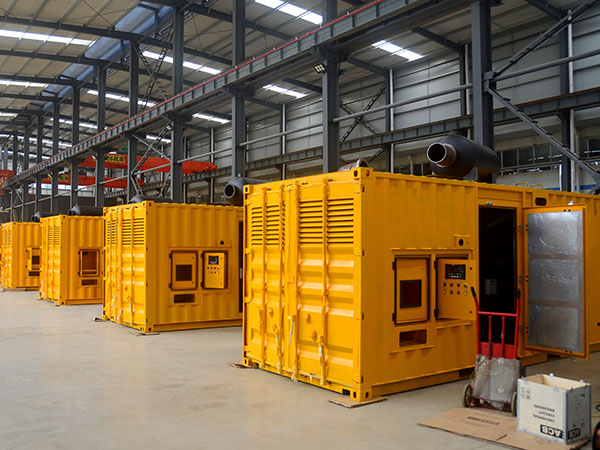
Containerized Type Yuchai Diesel Generator 1000KW Delivery to Russia


1000KW Diesel generator for the data center backup power in Russia
The 1000kw diesel generator will be used as standby power supply for the data center. Non standard container canopy is chosen. It is powered by Yuchai YC6C1660-D31, 12 cylinder engine.
The “Backup Power Heart” of the Frozen Plains: A 1000kW Diesel Generator Set Faces the Ultimate Test at a Moscow Data Center
Amidst the biting cold of a Moscow winter—when temperatures plummet below minus 30 degrees Celsius—it is not only human breath that turns to icy mist; the very “heart” of the digital world—the data center—also faces its most rigorous trial.
For data centers situated in Moscow, a reliable power supply serves as the absolute baseline for maintaining the stability of national financial, governmental, and cloud computing operations. In this city, backup power systems are not mere decorative fixtures, but essential tools for survival. In this silent race for reliability, 1000kW-class diesel generator sets—distinguished by their exceptional power density and adaptability to specific environments—have emerged as a pivotal piece of the puzzle within the Tier III redundancy architecture of modern data centers.
The Challenge: Physical Bottlenecks in Extreme Cold Environments
Operating a data center in Moscow requires addressing a primary challenge that precedes even the issue of computing power density: the physical constraints that the laws of nature impose upon machinery.
Standard diesel generator sets face extreme difficulty in starting up within sub-zero environments. Low temperatures cause engine oil viscosity to surge dramatically—thickening like glue to impede piston movement. Furthermore, paraffin within the diesel fuel can crystallize and precipitate, clogging fuel lines; meanwhile, the battery—critical to the ignition process—may see its effective capacity plummet to less than 50% of its normal operating level when temperatures drop to minus 20 degrees Celsius.
To address this critical pain point, the 1000kW backup power systems deployed in Moscow must possess “cold-resistant DNA.” Adhering to the latest technical standards for low-temperature starting, modern high-performance generator sets typically employ a synergistic design featuring fully insulated enclosures and controllable air intake preheating systems. In the critical moments when a startup is required, the system executes an “intermittent preheating cycle.” Through repeated heating phases and thermal diffusion, this process ensures that the temperature within the engine cylinders reaches the critical threshold required for diesel compression ignition, thereby enabling the unit to assume the electrical load—and bridge the power gap left by a utility outage—within a matter of mere seconds.
Installation of Thermal Insulation in the container:
The interior surfaces of the container’s side panels, door panels, and ceiling are lined with high-density rock wool or fiberglass wool. These two materials are widely adopted industry solutions, offering both thermal insulation and supplementary soundproofing benefits.
Addressing “Air Leakage Points”:
Air Intake/Exhaust Vents: Replace standard louvers with insulated, motorized louvers. When the generator set is shut down, these louvers automatically close to block out cold air; conversely, they open automatically when the generator starts up to ensure proper ventilation.
Cable Entry/Exit Points:
Seal the gaps around cable penetrations using sealant to prevent drafts from carrying away heat.
Container Structure Upgrades:
For regions experiencing extreme cold (e.g., temperatures below -30°C), a customized container featuring thickened exterior walls.
Passive thermal insulation can only slow down heat loss; in extremely cold environments, one must rely on an active heating system to maintain the unit’s internal temperature—its “body heat”—at a level that ensures normal startup and operation.
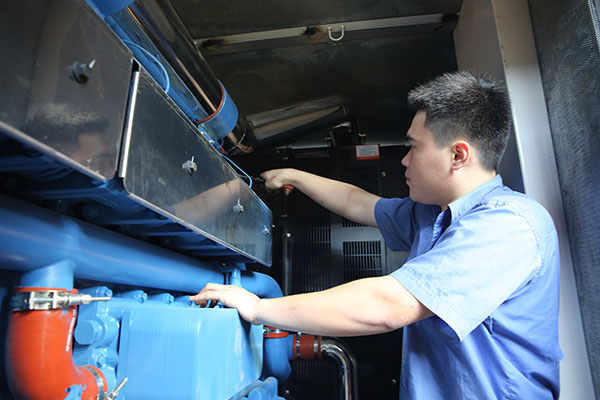
Jacket water and lubricating oil Heating (Core Component):
At low temperatures, antifreeze and engine oil can become viscous or even solidify, preventing the engine from starting. A forced-circulation jacket water heater installed on the generator set; this device preheats the coolant, utilizing thermal circulation to keep the engine block in a “warmed-up” state, thereby ensuring smooth startup at any time.
Air Heating (Optional): If the ambient temperature is extremely low (e.g., -40°C), simply preheating the engine is insufficient. A convective interior heating system or radiators can be installed inside the enclosure to maintain the internal container temperature within an ideal operating range of approximately 10°C.
 |
 |
Architecture: The Role of “1000kW” in N+1 Redundancy
Why is it, specifically, the 1000kW power segment that has garnered such favor among data center operators in Moscow?
Taking a typical modern data center in Moscow as an example, the total IT load is often planned to fall within the range of 3 MW to 5 MW. Relying on a single high-capacity unit not only introduces the risk of a single point of failure but also leads to “carbon buildup” issues when operating under low-load conditions. Consequently, engineering teams tend to favor an N+1 redundant parallel configuration—for instance, establishing a backup power matrix comprising 4 to 5 parallel-connected 1000kW units.
This configuration offers a high degree of flexibility:
Phased Expansion: As the data center’s rack utilization rate increases, additional units can be brought online incrementally, thereby avoiding the need for a single, massive capital expenditure upfront.
Load Optimization: During multi-cloud operations or periods of low demand, an intelligent control system can be utilized to activate only the necessary number of units. This ensures they operate within the optimal economic load range of 75% to 85%, thereby maximizing fuel efficiency while simultaneously extending engine lifespan.
Maintenance Isolation: When a specific unit requires maintenance, the remaining units can still satisfy the N-redundancy requirements, thereby guaranteeing business continuity.
Yuchai engine 1000KW diesel generator advantage
Historically, the market for high-end, high-power diesel generators was long monopolized by a handful of major European and American corporations. However, with the rise of China’s manufacturing sector and the realignment of global supply chains, power generation technology in the 1000kW class has reached a level of maturity. For instance, a new generation of 1000kW generator has begun to incorporate high-pressure common rail injection and electronically controlled high-pressure ratio turbocharging technologies; their transient response performance is now robust enough to effectively handle the drastic load fluctuations typical of data center servers.
To counter potential harmonic interference or voltage dips within Moscow’s utility grid, advanced 1000kW units are equipped with Permanent Magnet Generator (PMG) excitation systems, endowing them with exceptional motor-starting capabilities and robust resistance to the impact of non-linear loads. In the event of a utility power outage—once the UPS (Uninterruptible Power Supply) has exhausted its critical 15-minute battery reserve—the diesel generator set must be capable of transitioning from a standstill to full-load output within just 10 seconds; this requirement places extremely stringent demands on the control precision of both the governor and the AVR (Automatic Voltage Regulator).
|
1000KW Diesel Generator Ratings |
|
Voltage |
HZ |
Phase |
P.F |
Standby/Prime Amps |
Standby Power (KVA) |
Prime Power (KVA) |
|
400/230V |
50 |
3 |
0.8 |
1980/1800 |
1375 |
1250 |
Prime power (PRP): Prime power is available for an unlimited number of annual hours in available load application, in according with GB/T2820-97(EQVLso8528); A 10% overload capability is available for a period of 1 hour within a 12-hour period of operation.
Standby power Rating (ESP): The standby power rating is application for supplying emergency power for the duration of a utility power interruption. No overload, utility parallel or negotiated outage operation capability is available at this rating.
|
Sales Promises |
We provide a full line of brand new and high quality products. Each and every unit is strictly on load test before delivery. Warranty is according to our standard conditions: 12 months or 1500 running hour’s, subject to the earlier one. Service and parts are available from our factory or distribution in your location.
|
ENGINE DATA |
|
Manufacturer /Model |
Yuchai / YC12VTD1680L-D30 |
|
Air intake System |
Turbocharged & Intercooled |
|
Cylinder Arrangement |
12, V-configuration |
|
Displacement |
39.2L |
|
Bore and Stroke |
152×180mm |
|
Compression Ratio |
14:1 |
|
Rated RPM |
1500rpm |
|
Rated power at rated RPM |
1120KW |
|
Max standby Power at Rated RPM |
1230KW |
|
Fuel supply system |
Common Rail |
|
Oil capacity |
210L |
|
Rated fuel consumption |
195g/kw.h |
|
Oil consumption |
≤1.0g/kw.h |
|
Engine size |
2988*2100*2190mm |
|
Engine weight |
4200KG |
|
ALTERNATOR SPECIFICATION |
|
General data |
Compliance with GB755, BS5000, VDE0530, NEMAMG1-22, IED34-1, CSA22.2 and AS1359 standards.
|
Alternator Data |
|
Manufacture /Type |
Leory Somer LSA50.2 M6 |
|
Number of Phase |
three |
|
Connecting Type |
3 Phase and 4 wire |
|
Number of Bearing |
one |
|
Power Factor |
0.8 |
|
Protection Grade |
IP23 |
|
Altitude |
≤1000m |
|
Exciter Type |
Brush less, self-exciting |
|
Insulation Class, Temperature Rise |
H/H |
|
Voltage Regulation, Steady State |
≤1.5% |
|
Alternator Capacity |
1250KVA |


