
新闻
新闻 行业新闻 Buy Smart 7 Red Flags in Yuchai Marine Generator Quotes

目录

    Buy Smart 7 Red Flags in Yuchai Marine Generator Quotes

    2026-08-28 00:00:09
    通过管理员

    A Yuchai Marine Generator quote is ready for comparison only when it identifies the rating basis, electrical output, engine, alternator, control system, marine document scope, installation interfaces, tests, and commercial terms. A price beside a kW or kVA figure is not enough.

    Two quotations can use the same product name while describing different equipment. When a critical field is blank, request a written revision before comparing prices.

    What Should a Complete Yuchai Marine Generator Quote Show?

    Start with seven groups of information.

    Red Flag Buyer Risk Required Fix
    Rating basis is absent Outputs may describe different duties or components State genset output, unit, duty, frequency, and reference conditions
    Engine model is generic The proposed engine cannot be matched to the output Add the complete Yuchai engine model and rated speed
    Electrical output is incomplete The set may not match the vessel distribution system Add voltage, frequency, phase, wiring, and power factor
    Components are called standard Alternator and control scope remain open Name each brand, model, and included option
    Marine approval is vague Certificate scope and cost cannot be checked Identify the required approval and covered equipment
    Installation interfaces are missing Layout and connection work remain undefined Add drawings, dimensions, weight, and interface data
    Tests and terms are vague Acceptance and landed scope remain uncertain List tests, documents, packing, warranty basis, and trade term

    UleenGen’s catalog lists Yuchai-powered sets from 30 to 2,000 kW with 50/60 Hz availability at the series level. Those figures do not rate a particular marine set; the selected model and project conditions control the quote.

    Red Flag 1: The Quote Lists kW or kVA Without a Rating Basis

    A bare power figure is the first reason to pause. It does not say whether the number describes the engine or the complete generating set, and it does not define the intended duty.

    The quotation should separate genset output from engine output and name the duty, frequency, rated speed, and reference conditions. UleenGen’s technical materials keep prime and standby ratings separate and prohibit merging figures from different frequencies or configurations.

    Ask for one line that binds the model, output unit, duty, frequency, and operating basis.

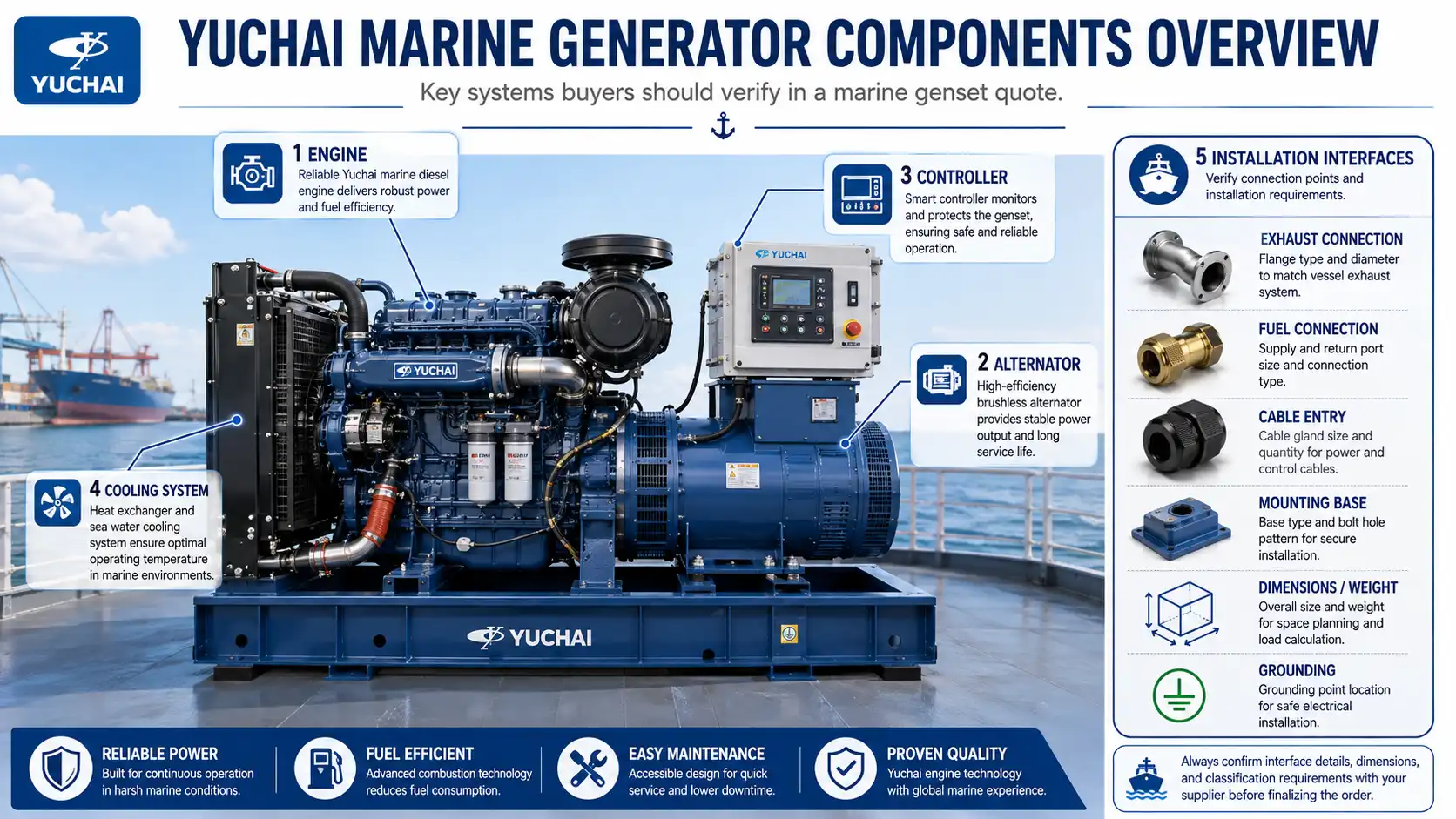
    Yuchai marine generator components overview showing engine, alternator, controller, cooling system, and installation interfaces

    Red Flag 2: The Exact Yuchai Engine Model Is Missing

    “Yuchai engine” names a manufacturer, not a configuration. UleenGen’s catalog includes several Yuchai families, including YC4D, YC4A, YC6B, YC6A, YC6M, and YC6T. A supplier must identify which engine sits in the offered set.

    Request the complete engine designation and rated speed, then match them to the genset model and output. Do not transfer displacement, fuel consumption, dimensions, or other figures from a nearby model.

    玉柴系列船用发电机 entry can establish the product category. The quotation must carry the project-specific identity.

    Red Flag 3: Voltage, Frequency, Phase, or Wiring Is Unclear

    For an American buyer, 60 Hz may be a likely starting point. It is not a substitute for the vessel’s electrical schedule.

    The supplier needs the voltage, frequency, phase, wiring, and power factor. UleenGen’s catalog presents 50/60 Hz and single- or three-phase choices for several families, so the selection cannot be inferred from the brand name.

    Send the load list and vessel distribution values. The revised quotation should repeat them rather than leave them in an email thread.

    Red Flag 4: The Alternator and Control System Are “Standard”

    “Standard alternator” leaves a major component unidentified. UleenGen’s catalog names Stamford, Leroy Somer, Mecc Alte, Marathon, EvoTec, and Wattek among available alternator brands, while its controller list includes several different models. Availability does not mean every choice is included in every set.

    Require the alternator brand and model, controller, circuit breaker, monitoring equipment, and any automatic or parallel-control option. Mark each as included, optional, or excluded.

    The broader marine generator options can help define the category. The signed quotation should name the actual components being supplied.

    Red Flag 5: Marine Certification Is Mentioned Without Scope

    A line that says “marine certificate available” does not identify the approval, the covered equipment, or the documents included in the price. Treat it as an open item.

    Give the supplier the required approval scope. The revised quote should name the requirement, covered equipment, deliverable documents, and any separate charge. An engine document does not automatically define coverage for the alternator or assembled genset.

    If the owner, yard, or reviewing authority has not set the requirement, keep the item pending.

    Red Flag 6: Cooling, Exhaust, Mounting, and Connections Are Omitted

    A generator has to fit the machinery space and meet the vessel’s connection points. The quotation therefore needs more than the engine and alternator names.

    Request an outline drawing with dimensions and weight. Review the cooling arrangement, exhaust connection, base frame, vibration isolation, fuel connections, starting system, cable interface, and grounding. UleenGen’s installation guidance covers ventilation, exhaust, foundation, fuel piping, grounding, and electrical connection; exact arrangements remain project-dependent.

    For a replacement, send the available space, access route, existing interfaces, electrical schedule, and load information. The supplier can then return a configuration-based drawing and scope.

    Red Flag 7: Tests, Documents, Warranty, and Delivery Terms Are Vague

    The final red flag sits at the boundary between technical acceptance and the purchase contract. Words such as “tested,” “manual included,” or “standard warranty” need definitions.

    List the required test report, drawings, electrical schematic, manuals, packing, and agreed spare parts. UleenGen materials show that these items can appear in a supply scope, but inclusion must be confirmed for the selected marine set.

    Put the warranty start point, time limit, running-hour limit, remedy, and exclusions into the contract. An existing UleenGen manual states 12 months or 1,500 running hours, whichever occurs first, under its maintenance and quality-problem conditions. Confirm the current sale terms separately.

    Finish with the trade term, named place or port, packing, and delivery scope. The generator service and technical support information can guide questions; the quotation remains the project record.

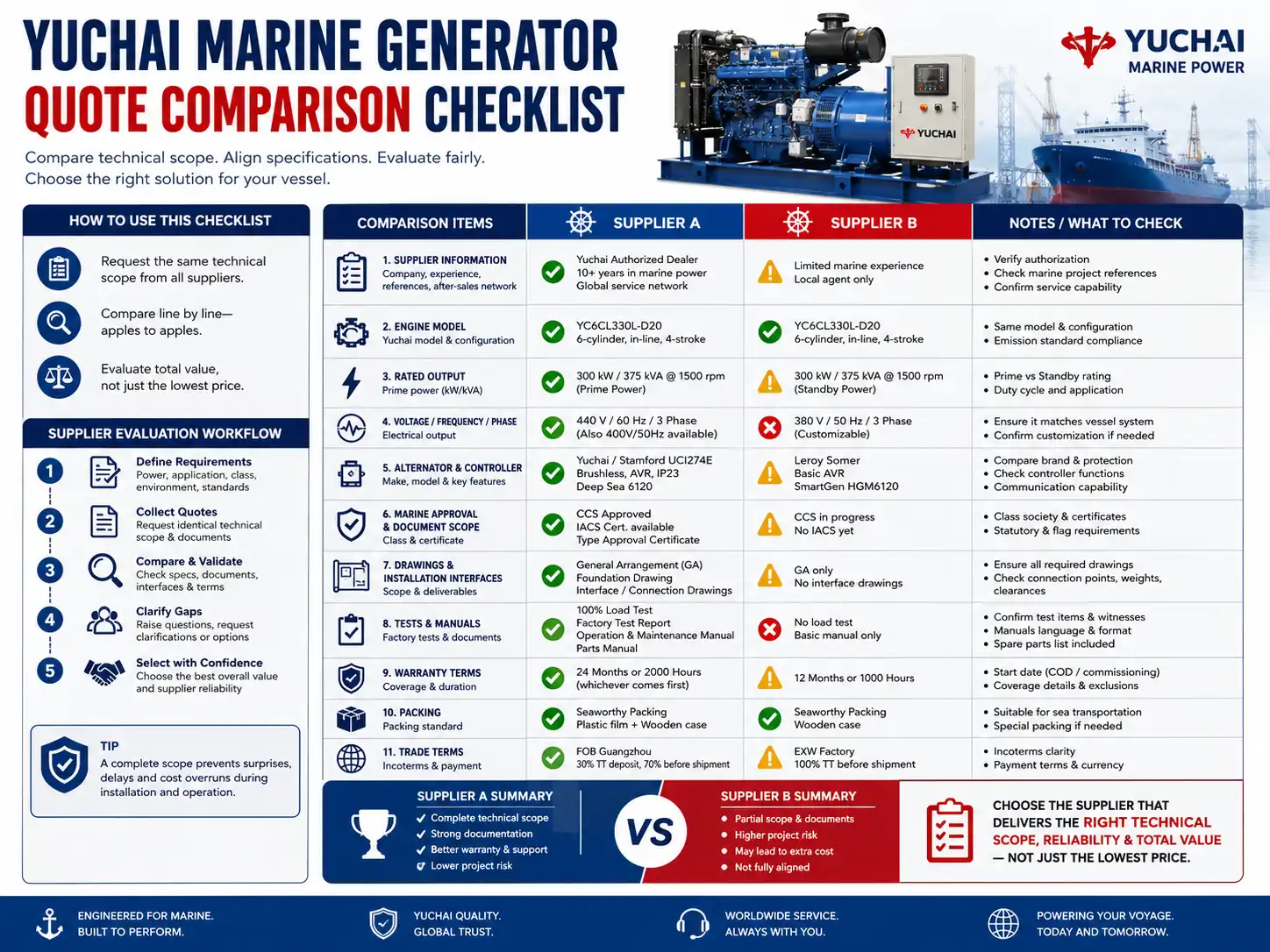
    Comparison checklist for Yuchai marine generator quotes showing supplier specifications, documents, warranty, and technical scope

    How Can You Compare Two Yuchai Marine Generator Quotes?

    Normalize the offers before deciding which price is lower. Keep unresolved cells visible.

    Comparison Field Supplier A Supplier B
    Genset model and rated output Record exact wording Record exact wording
    Duty, frequency, voltage, phase, wiring Match one project basis Match one project basis
    Yuchai engine model and rated speed Name and verify Name and verify
    Alternator, controller, breaker, options Included / optional / excluded Included / optional / excluded
    Marine approval and document scope Name covered items Name covered items
    Drawings, interfaces, dimensions, weight Received / pending Received / pending
    Tests, manuals, spares, packing List each item List each item
    Warranty and trade term State full basis State full basis

    Compare price only when both columns describe the same duty and supply scope. Return any proposal that still says “standard” with the missing field highlighted.

    Send UleenGen a Quote That Can Be Checked Line by Line

    Shandong Uleen Generator Co., Ltd. lists Yuchai-powered sets and multiple alternator and controller choices. A marine inquiry must narrow those choices to one documented configuration.

    Use the configuration-based quote request to send the load, duty, electrical values, vessel type, installation space, interfaces, destination, approval requirement, tests, and documents. Request a model recommendation with named components, confirmed interfaces, document scope, and a line-by-line price.

    That is the point of the review: make the price describe a specific generator set.

    常见问题解答

    Q1: What information is needed to quote a Yuchai marine generator?

    A: Send the load, duty, electrical values, vessel type, installation limits, cooling and exhaust interfaces, destination, and approval requirement. State which tests, drawings, manuals, spare parts, and packing must be included.

    Q2: Should a U.S. vessel always order a 60 Hz marine generator?

    A: No. Use the vessel’s electrical schedule. UleenGen’s catalog shows 50/60 Hz availability at the series level, but the selected frequency, voltage, phase, wiring, engine speed, and output must be confirmed together for the actual model.

    Q3: Is the alternator included with a Yuchai marine engine quote?

    A: The wording decides. An engine quote and a complete generating-set quote are different scopes. Require the alternator brand and model, controller, breaker, base frame, and included accessories to appear as separate lines before treating the offer as a complete genset price.

    Q4: Does every Yuchai marine generator include classification documents?

    A: The available UleenGen material does not support that blanket conclusion. Give the supplier the required approval scope and ask the quote to identify the covered engine, alternator, assembled set, documents, and charges. Leave the requirement pending when the project authority has not defined it.

    Q5: How can two Yuchai marine generator prices be compared fairly?

    A: Put both offers on the same output, duty, and electrical basis. Then align the components, documents, interfaces, tests, packing, warranty, and trade term. Compare totals only after every included, optional, excluded, and pending item is visible.