


联系我们
-
中国山东省潍坊市高新区软件园3-2-1003
- +8615095247272
- sales@uleengen.com
-


Diesel Generator Power Range Guide from 30kVA to 500kVA
A 30kVA Diesel Generator and a 500kVA Diesel Generator sit in very different projects. One may carry a small group of essential circuits; the other may supply a factory load group. In both cases, the nameplate rating is only the first number to check. Motors, pumps, compressors, UPS equipment, and local site conditions all affect the choice.
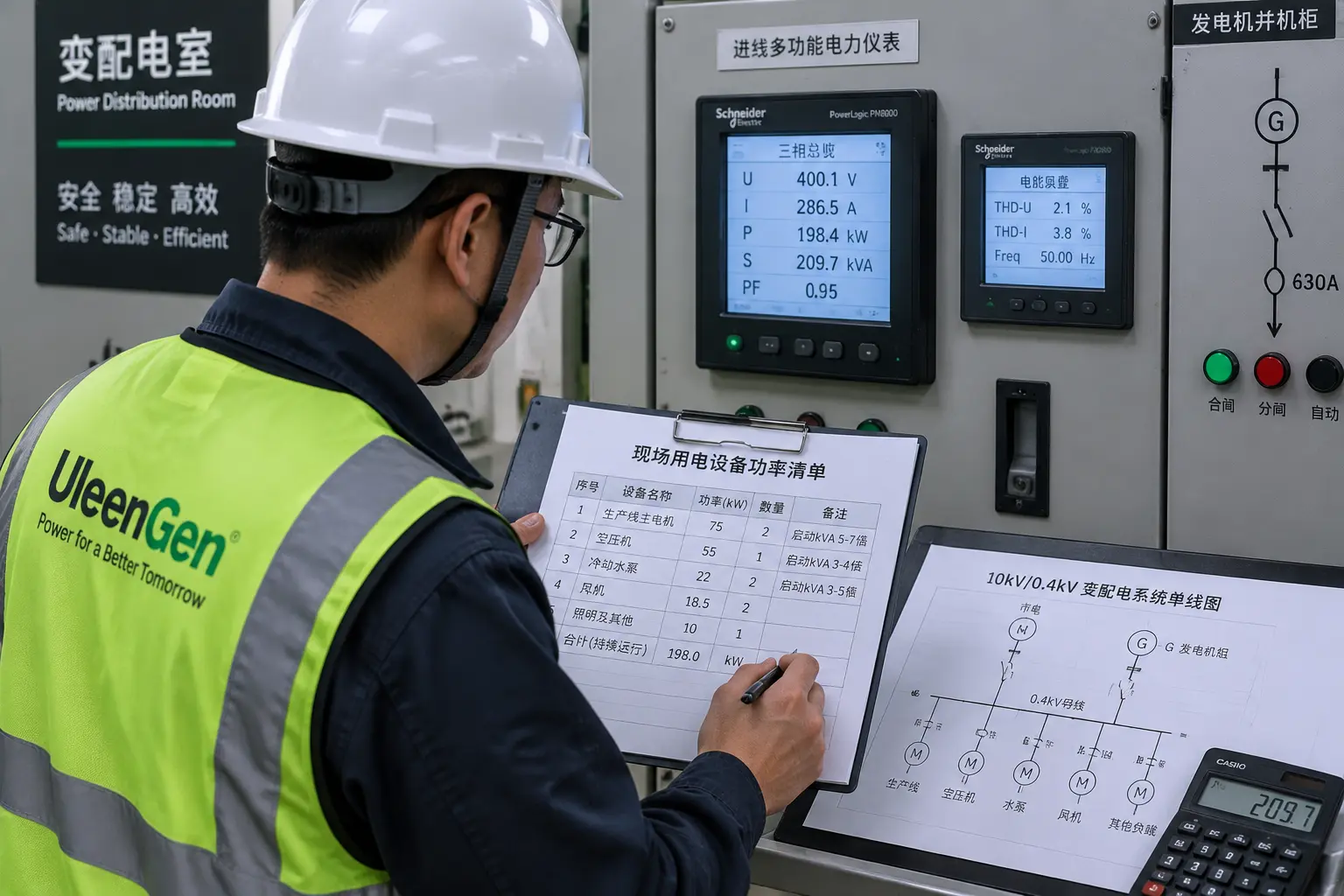
Begin with a load schedule that records what must operate, what can remain disconnected, and which equipment starts under an existing base load. Use it to select the duty rating and electrical specification before comparing engines, alternators, enclosures, and controls.
Diesel Generator Power Range at a Glance
Most three-phase industrial generator sets are quoted in kVA at a stated power factor. At a 0.8 power factor, the reference conversion is kW = kVA × 0.8. A 100kVA set therefore corresponds to 80kW at that power factor. Treat the result as an initial reference because the selected model may have separate prime and standby ratings.
| Power band | Reference output at 0.8 PF | Typical selection focus |
|---|---|---|
| 30-50kVA | 24-40kW | Essential loads, portability, phase, and noise |
| 50-100kVA | 40-80kW | Several commercial loads, motor starting, and ATS operation |
| 100-200kVA | 80-160kW | Load sequencing, pumps, workshops, and facility backup |
| 200-500kVA | 160-400kW | Industrial loads, large motors, controls, transport, and fuel storage |
The boundaries overlap in real projects. A 95kVA calculation makes a 100kVA Diesel Generator look like a close match. One large motor start or a high ambient temperature may push the requirement into the next band. Planned expansion can do the same.
How to Choose the Right Diesel Generator Size
Two conditions usually drive the load study: normal operation and the hardest realistic starting event. The calculation also needs a stated duty and a set of environmental conditions.
List the Loads That Must Run
Create a table for the equipment connected to the generator. For each item, record running kW or kVA, power factor, quantity, starting method, and operating priority. Mark any load that can be shed during an outage. Calculate the total from loads that run in the planned sequence.
The engine supplies real power in kW. The alternator and electrical system carry apparent power in kVA and the associated current. Both sides of the set must match the load.
Check Starting and Step Loads
Motors and compressors can draw far more during startup than during normal operation. Pumps, lifts, transformers, and some electronic equipment can also create a sharp step load. Note the base load already connected when the largest item starts, then specify whether it uses direct-on-line, star-delta, soft-start, or variable-frequency-drive control.
Give that starting event to the supplier for an engine and alternator check. The result should show voltage dip, frequency dip, and recovery time. This catches a common sizing problem: enough kW for normal operation, followed by an unacceptable dip when the largest motor starts.
Select the Correct Duty Rating
Standby power is intended for emergency operation during a utility interruption. Prime power applies to longer operation with a variable load under the engine maker’s published conditions. Continuous power applies to a constant load under its stated rating rules.
Put the required duty in the inquiry. Ask for prime and standby values in both kW and kVA, with the operating-hour, overload, and average-load conditions attached. Compare quotations on the same rating basis.
Apply Site and Electrical Conditions
State the destination and the site’s altitude, maximum ambient temperature, humidity, dust level, and ventilation arrangement. Include the local emissions requirement. Because heat and altitude can reduce usable output, ask for a derating calculation for the exact engine and alternator combination.
Confirm 50Hz or 60Hz, voltage, phase, wiring system, and load power factor. Frequency can change the engine speed and available model. Single-phase output, severe phase imbalance, nonlinear loads, and harmonic-producing equipment also require a specific check.
30-50kVA Diesel Generator for Compact Load Groups
At 0.8 power factor, a 30kVA Diesel Generator has a reference output of 24kW. Buyers often consider this band for a small commercial site, farm equipment, a telecom load, a site office, or selected emergency circuits. A compact set can still face a demanding start if a pump or compressor is part of the load.
这 30-50kVA diesel generator range includes several voltage, phase, engine, and set-format options. An open set belongs in a suitable plant room. A silent enclosure may fit a site close to occupied areas. For work that moves between locations, consider a trailer. Add the required fuel autonomy and handling method to the inquiry.
Next power range: 50-100kVA Diesel Generator.
50-100kVA Diesel Generator for Growing Commercial Loads
Between 50kVA and 100kVA, the reference output runs from 40kW to 80kW at 0.8 power factor. The lower end may carry a defined group of smaller loads. Near 100kVA, the schedule often includes more three-phase equipment and a more involved restart sequence.
Review the 50-100kVA generator models with the running and starting figures in hand. If the set will start automatically after a utility failure, document which circuits return first and which can wait. The ATS must match the design for current rating, pole arrangement, interlocking, and control logic.
Previous power range: 30-50kVA. Next power range: 100-200kVA.
100-200kVA Diesel Generator for Facilities and Light Industry
Workshops, processing lines, commercial buildings, and agricultural facilities often compare sets in the 100-200kVA band. At 0.8 power factor, that represents a reference 80-160kW. Several pumps or motors can make the restart sequence as important as the running total, particularly after a full-site outage.
Compare configurations in the 100-200kVA industrial generator range once the load study is ready. For a 200kVA Diesel Generator, confirm where the 160kW reference sits in the prime and standby data for the selected model. The site review should cover enclosure ventilation, exhaust routing, fuel supply, cable size, protection settings, and maintenance clearance.
Previous power range: 50-100kVA. Next power range: 200-500kVA.
200-500kVA Diesel Generator for Industrial Projects
At the top half of this guide, 200-500kVA represents a reference 160-400kW at 0.8 power factor. Buyers may evaluate these sets for production, infrastructure, mining, construction, and large facility backup. The load schedule still decides the size. A long list of applications cannot substitute for the project’s electrical data.
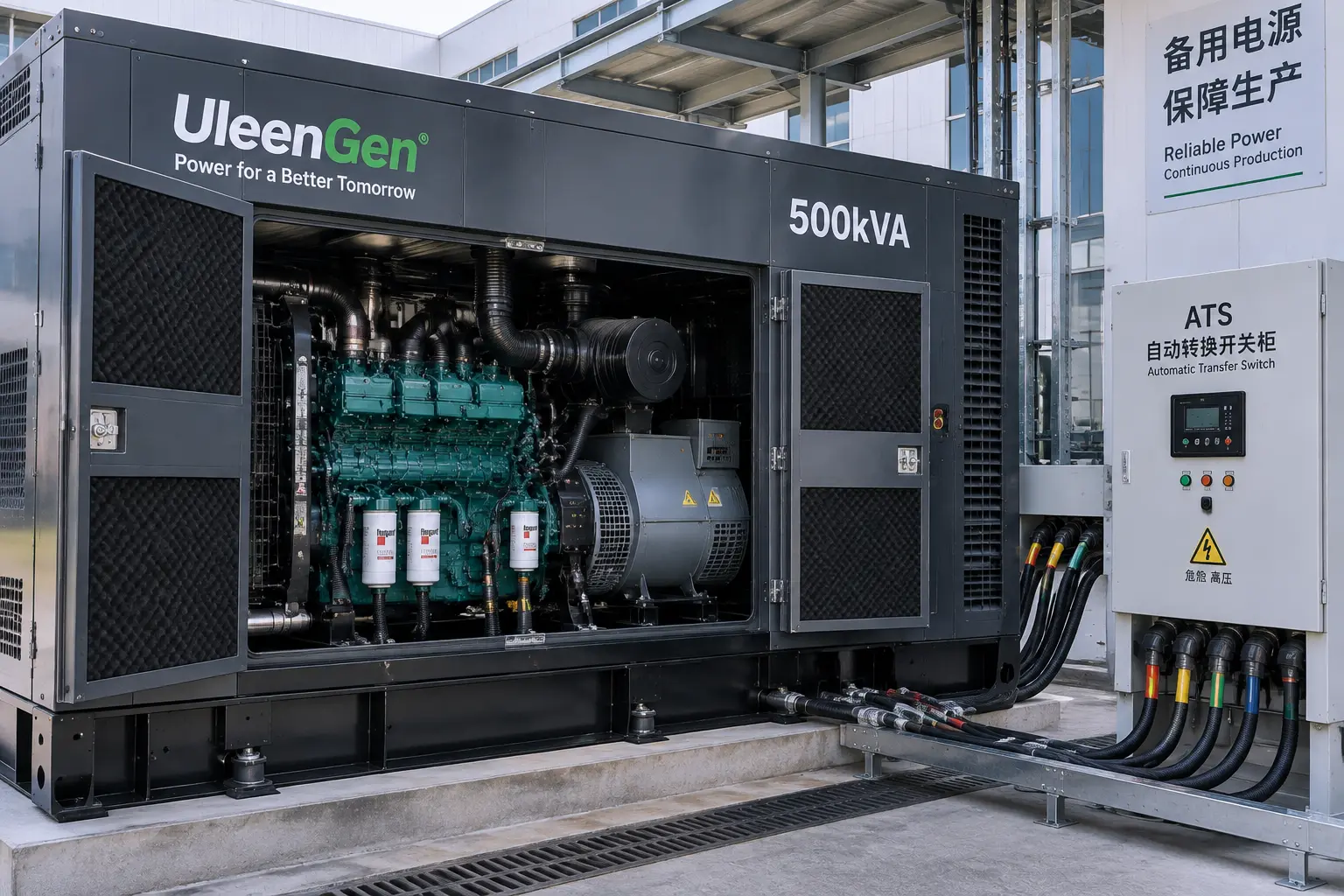
这 200-500kVA generator sets are available in open, silent, and mobile formats, with choices for the alternator, controller, and monitoring system. The design brief should state load steps, the largest motor start, permitted voltage dip, and any synchronization requirement. It should also say whether one set or a parallel system is planned.
Transport details are easy to leave until late in the project, when they become expensive to fix. Request finished dimensions and gross weight for the quoted enclosure. Check lifting points, door and service clearances, radiator airflow, exhaust routing, tank capacity, and foundation loads. Base the fuel plan on required operating hours and consumption figures for the exact engine at stated load percentages.
Previous power range: 100-200kVA Diesel Generator.
Choose the Engine After Defining the Power Range
Once the power band is clear, compare the available diesel generators by engine. The shortlist should name the engine, alternator, and controller model for each set. Review rated speed, governing method, cooling arrangement, prime and standby output, fuel data, and frequency compatibility.
The engine choice also affects maintenance after delivery. Ask who supplies filters, belts, sensors, and major parts in the destination market, and record the usual lead times. A familiar engine family can simplify fleet maintenance if the chosen model also meets the electrical and site requirements. The quotation should identify service intervals, recommended on-site spares, warranty responsibility, and the information needed for remote diagnosis.
Configuration Checklist for Global Buyers
Send the same project brief to every supplier. Include:
-
Load schedule with running power, power factor, starting method, and operating sequence
-
Standby, prime, or continuous duty and expected annual operating hours
-
Voltage, 50Hz or 60Hz frequency, phase, and wiring system
-
Maximum motor or step load and permitted voltage and frequency dip
-
Altitude, temperature, humidity, dust, ventilation, and emissions requirements
-
Open, silent, trailer, or other enclosure format
-
Required fuel autonomy, external tank interface, and fuel-quality conditions
-
Controller, ATS, remote monitoring, synchronization, and protection functions
-
Alternator model, insulation, protection class, excitation system, and voltage regulation
-
Finished dimensions, weight, lifting method, cable entry, and maintenance access
-
Factory test scope, test report, manuals, wiring diagrams, packing list, and spare-parts list
-
Warranty period, claim process, commissioning responsibility, and destination support
Keep rating conditions beside every numerical value. A fuel-consumption figure needs the engine model, frequency, load percentage, and unit. Noise data needs the measuring distance and test condition. List a larger tank, remote controller, alternator heater, engine heater, or automatic synchronization as an option unless the quoted standard configuration includes it.
关于 UleenGen
UleenGen supplies diesel generator sets across the power bands covered here, in open, silent, and mobile trailer formats. Its product materials list engine and alternator choices, control panels, ATS functions, remote monitoring, fuel-tank configurations, protection functions, manuals, and test reports. Send the load schedule with the required duty, electrical specification, site conditions, enclosure, and destination. The quotation can then identify the selected components, rating basis, included accessories, test scope, and commercial terms.
常见问题解答
Q1: What Size Diesel Generator Do I Need?
A: Add the loads that must run at the same time, convert them to kW and kVA using their actual power factors, and test the largest starting event. Then apply the required duty rating and model-specific site derating. A supplier or qualified engineer should validate critical and motor-heavy applications.
Q2: How Many kW Does a 100kVA Diesel Generator Provide?
A: At a 0.8 power factor, 100kVA corresponds to 80kW. Confirm whether the stated value is prime or standby power and check the selected model’s frequency and reference conditions.
Q3: What Is the Difference Between Prime and Standby Ratings?
A: Standby rating applies to emergency operation during a utility interruption. Prime rating applies to longer variable-load operation under the engine maker’s conditions. Operating-hour, overload, and average-load limits depend on the published rating definition.
Q4: Can a 200kVA or 500kVA Diesel Generator Start Large Motors?
A: The nameplate rating alone cannot answer this. The check requires the motor’s running power, power factor, starting method, starting current, connected base load, permitted voltage dip, and the selected engine and alternator response.
Q5: Should You Choose the Engine Before the Generator Power Range?
A: Define the load, duty, electrical system, and site conditions first. Use the resulting power band to compare engine models that meet the required frequency, rating, transient response, emissions rules, and maintenance plan.


