



Свяжитесь с нами
-
3-2-1003 Software park, Weifang Hi-tech Zone, Шаньдун, Китай
- +8615095247272
- sales@uleengen.com
-


Top 5 Considerations Before Buying a Diesel Generator Set for Industrial Use


An industrial diesel generator purchase starts with a written load and duty brief. Record running load, motor-starting demand, operating hours, site conditions, electrical arrangement, service plan, and quotation scope before comparing model numbers. A kW figure cannot define the complete installation.
This guide covers five checks for engineers, contractors, project managers, rental-fleet buyers, and procurement teams. Use them to turn an equipment list into a comparable specification.
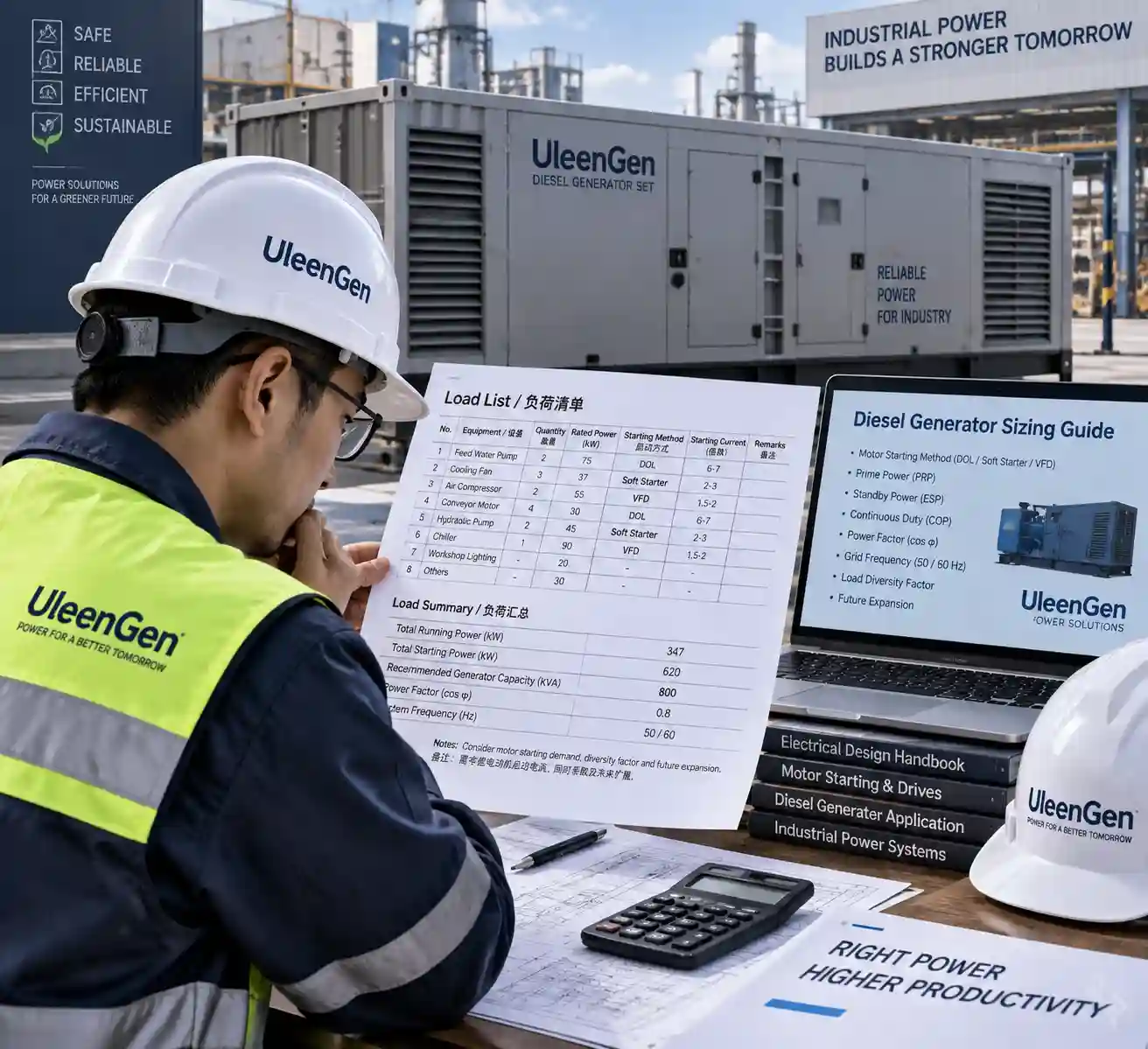
What Should You Check Before Buying a Diesel Generator Set?
Start with the project record. List each load, running kW or kVA, starting method, duty cycle, and outage priority. Add site and electrical details such as altitude, ambient temperature, ventilation, voltage, frequency, phase, transfer equipment, and grounding.
Define the Industrial Load and Duty
Separate Running kW, kVA, and Starting Demand
1. How Should You Size the Generator for the Industrial Load?
Generator-set output must cover the operating load and the largest expected load step under the selected rating. Record motors, compressors, pumps, welders, heaters, drives, lighting, controls, and battery chargers. Note whether each motor uses direct-on-line starting, a soft starter, or a variable-frequency drive. These details change the starting profile that the alternator and engine must handle.
Use the supplier’s rating definitions for prime, standby, or continuous duty. Prime power applies to a variable project schedule; standby power applies to emergency use during a utility outage. A continuous-duty project needs a matching rating and maintenance plan. Ask for the rating basis, power factor, frequency, and ambient conditions.
| Sizing input | What you should record | Why it affects selection |
|---|---|---|
| Running load | kW or kVA for every connected item | Sets the sustained output requirement |
| Starting demand | Motor size, starting method, and sequence | Sets voltage and frequency response requirements |
| Долг | Prime, standby, or continuous; annual hours | Determines the applicable rating and service plan |
| Load sequence | Which loads start together and which loads shed | Defines the largest step the set must accept |
| Power system | Voltage, frequency, phase, and power factor | Determines alternator and control configuration |
For an initial screen, compare your documented load band with diesel generator sets by power range. Treat a catalog range as a family guide. Confirm the exact model rating, engine, alternator, and test conditions before issuing a purchase order.
2. Which Site Conditions Change Generator Selection?
Air density, heat rejection, exhaust routing, and physical access influence the installation. Give the supplier site altitude and design ambient temperature, then request any required derating in the model-specific proposal. Air inlet, radiator discharge, and exhaust path affect usable load.
Plan ventilation openings, radiator airflow, exhaust back pressure, foundation strength, lifting points, and service clearances from the layout stage. Dust, rain, salt air, and wash-down routines affect enclosure and filtration choices. Record fuel type, tank position, refueling access, and cable distance to the main distribution board.
Projects with heat, altitude, dust, rain, long cable runs, or noise limits should send those conditions with the load schedule. The supplier can match cooling, enclosure, tank, and installation details during the design stage, giving the site team a defined configuration before delivery.
3. What Electrical Configuration Does the Industrial Project Need?
Confirm voltage, frequency, phase, neutral arrangement, fault level, breaker frame, and grounding method. A 50 Hz system and a 60 Hz system require different alternator and engine settings. Single-phase and three-phase distribution also require different connections. State the required power factor and the loads that create harmonics or rapid load changes.
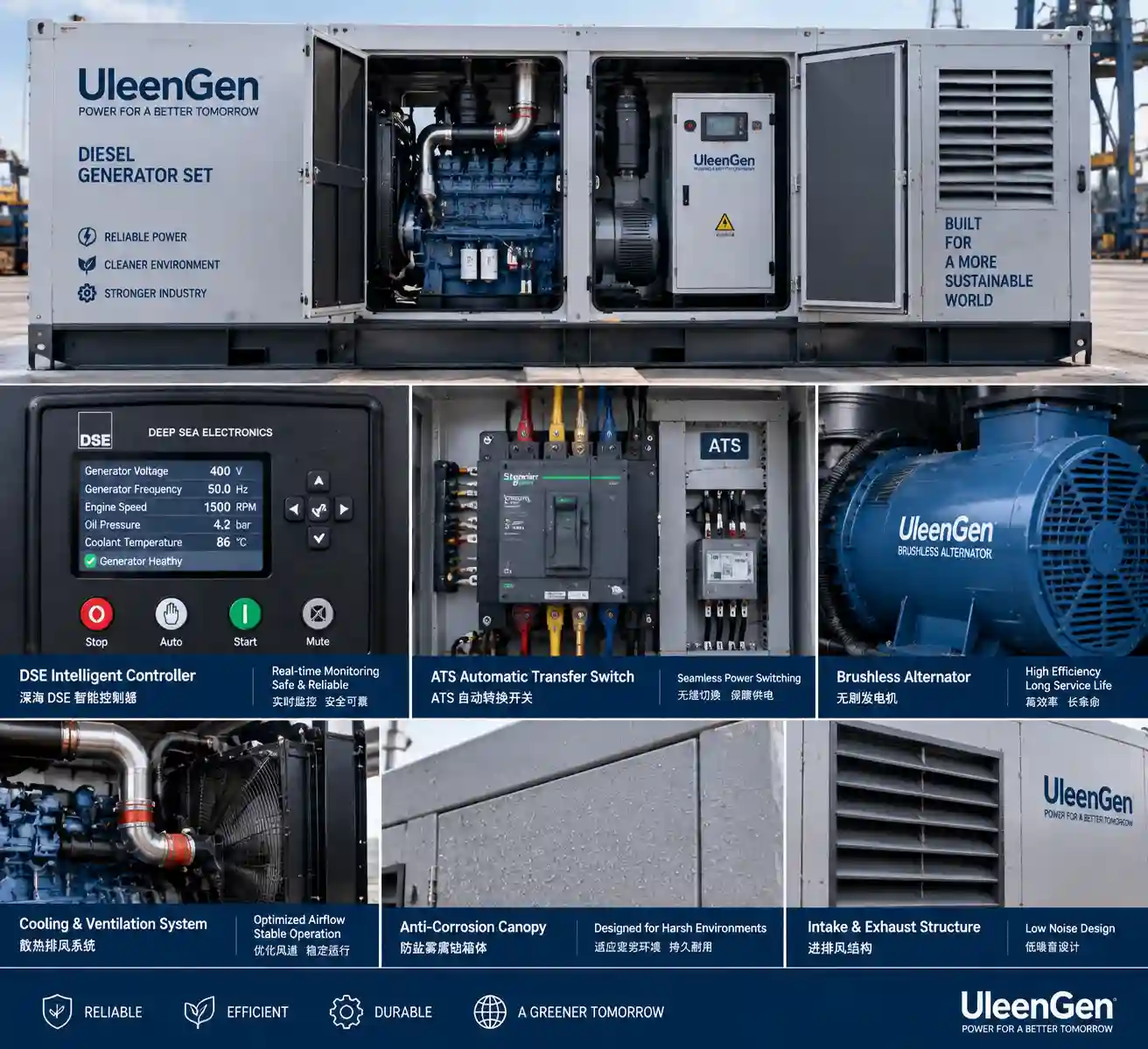
Decide how the set will connect to the facility. An automatic transfer switch (ATS) transfers selected loads between utility and generator sources. A paralleling or synchronization system allows multiple sets or a utility source to share load under a defined control scheme. Remote monitoring can expose running status, alarms, measurements, and service data when the project includes a compatible controller and communications plan.
Controller options listed for UleenGen packages include HGM6120, AMF25, DSE6120, DSE7320, HGM410, MRS16, DKG309, and DSE6020. Alternator options include Stamford, Leroy Somer, Mecc Alte, Marathon, EvoTec, and Wattek. These are configuration choices. Ask for the exact controller, alternator, breaker, protection functions, ATS or synchronizing equipment, and cable termination details. Review generator sets by engine and structure after the electrical brief is complete.
4. How Should You Evaluate Maintenance and Lifecycle Support?
Access around filters, batteries, belts, coolant drains, control panels, and lifting points affects routine work. Request the maintenance schedule for the proposed engine and alternator, along with the consumables list, recommended spares, and service records supplied at handover. The schedule should identify inspection tasks, fluid checks, filter changes, and load-test requirements for the selected duty.
Define who supplies commissioning, training, troubleshooting, warranty handling, and replacement parts. Document the response process for alarms and planned shutdowns. A remote-monitoring option supports status review when the controller, communications path, and data responsibility are listed.
UleenGen installation material covers ventilation, exhaust, foundation, clearances, grounding, utility and ATS connections, batteries, fuel, lifting, storage, and pre-start inspection. Use those subjects as a commissioning checklist, then request the model-specific drawings and instructions. A project that needs an installation method statement can also review generator installation and service support for the service scope to be confirmed in the quotation.
5. What Must an Industrial Diesel Generator Quotation Include?
A comparable quotation names the complete set, including the engine brand and headline output. Require the exact model, prime or standby rating, frequency, voltage, phase, power factor, ambient reference, and enclosure. Ask for the engine, alternator, controller, breaker, cooling system, batteries, charger, base frame, fuel tank, silencer, exhaust parts, ATS, synchronization equipment, and monitoring devices included in the price.
Request the documents your electrical and civil teams need:
-
rated and short-circuit data sheet;
-
dimensional, foundation, lifting, and cable-entry drawings;
-
wiring diagrams and ATS or synchronization logic;
-
operation, maintenance, and installation manuals;
-
factory test records and the stated test load or conditions;
-
packing list, exclusions, delivery point, warranty responsibilities, and payment terms.
Compare each offer line by line. UleenGen lists Cummins at 16–2,000 kW, Perkins at 8–1,800 kW, Yuchai at 30–2,000 kW, and Weichai at 20–1,200 kW at family level. Those ranges require model-specific confirmation of rating, frequency, phase, engine, alternator, and enclosure.
Select a Diesel Generator Set from a Complete Industrial Specification
The purchase decision is ready when the load schedule, duty rating, site inputs, electrical interface, maintenance responsibilities, and quotation documents describe one configuration. Send the supplier project location, voltage, frequency, phase, operating hours, starting data, altitude, ambient temperature, enclosure needs, ATS or synchronization plan, and drawings.
Shandong Uleen Generator Co., Ltd. supplies diesel generator families using Cummins, Perkins, Yuchai, and Weichai engines, with open, silent, trailer, and containerized structures. Its catalog lists alternator and controller options that can be matched to a project specification. Ask UleenGen for an itemized industrial diesel generator quotation that states the exact model, rating basis, component scope, test records, manuals, and installation assumptions.
Часто задаваемые вопросы
Q1: How do you choose a diesel generator for industrial use?
A: Start with a load schedule that lists running kW or kVA, motor-starting data, load sequence, duty, voltage, frequency, and phase. Add altitude, ambient temperature, ventilation, exhaust, enclosure, fuel, access, and transfer requirements before a supplier recommends a model.
Q2: Should an industrial site use prime or standby generator power?
A: Choose the rating that matches the operating pattern. Prime power serves a variable-load schedule with defined operating hours, while standby power serves emergency operation during utility outages. The quotation should state the rating definition and the applicable maintenance plan.
Q3: What site conditions can reduce usable generator output?
A: High altitude, high ambient temperature, restricted airflow, exhaust back pressure, dust loading, and enclosure layout can affect the usable output or service access. Provide these conditions to the supplier and request model-specific derating and installation data.
Q4: What electrical details should be checked before ordering?
A: Confirm voltage, frequency, phase, neutral and grounding arrangement, breaker and protection functions, power factor, ATS or synchronization method, cable entry, and monitoring interface. The supplier should identify each item for the exact engine, alternator, and controller combination.
Q5: What should an industrial diesel generator quotation include?
A: It should include the exact model, rating basis, engine, alternator, controller, enclosure, breaker, batteries, tank, exhaust parts, transfer or synchronizing equipment, drawings, manuals, test records, exclusions, delivery point, warranty responsibilities, and payment terms.


