



contact us
-
3-2-1003 Software park, Weifang Hi-tech Zone, Shandong, China
- +8615095247272
- sales@uleengen.com
-


Choosing a 500–1000 kVA Diesel Generator: Load, Rating and Expansion Plans


Put two offers on the desk: 500 kVA and 1000 kVA. The larger number looks reassuring until somebody asks what runs on the site today and what starts after the utility supply fails. If most hours are spent at a fraction of the larger set’s output, the difference in nameplate size has not settled the choice. It has exposed a question for the load study.
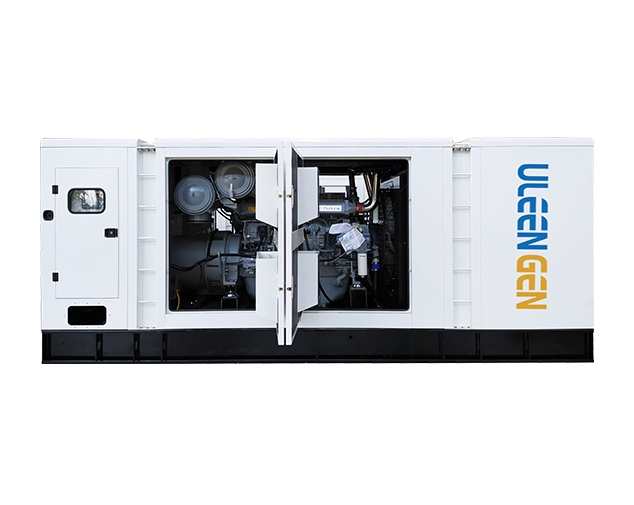
For a factory, commercial campus or infrastructure project, the load schedule is the document worth finishing first. It gives bidders a common basis and makes omissions visible. Our 500–1000 kVA diesel generator range can then narrow the model search. The actual set still has to match the duty and conditions on the schedule.
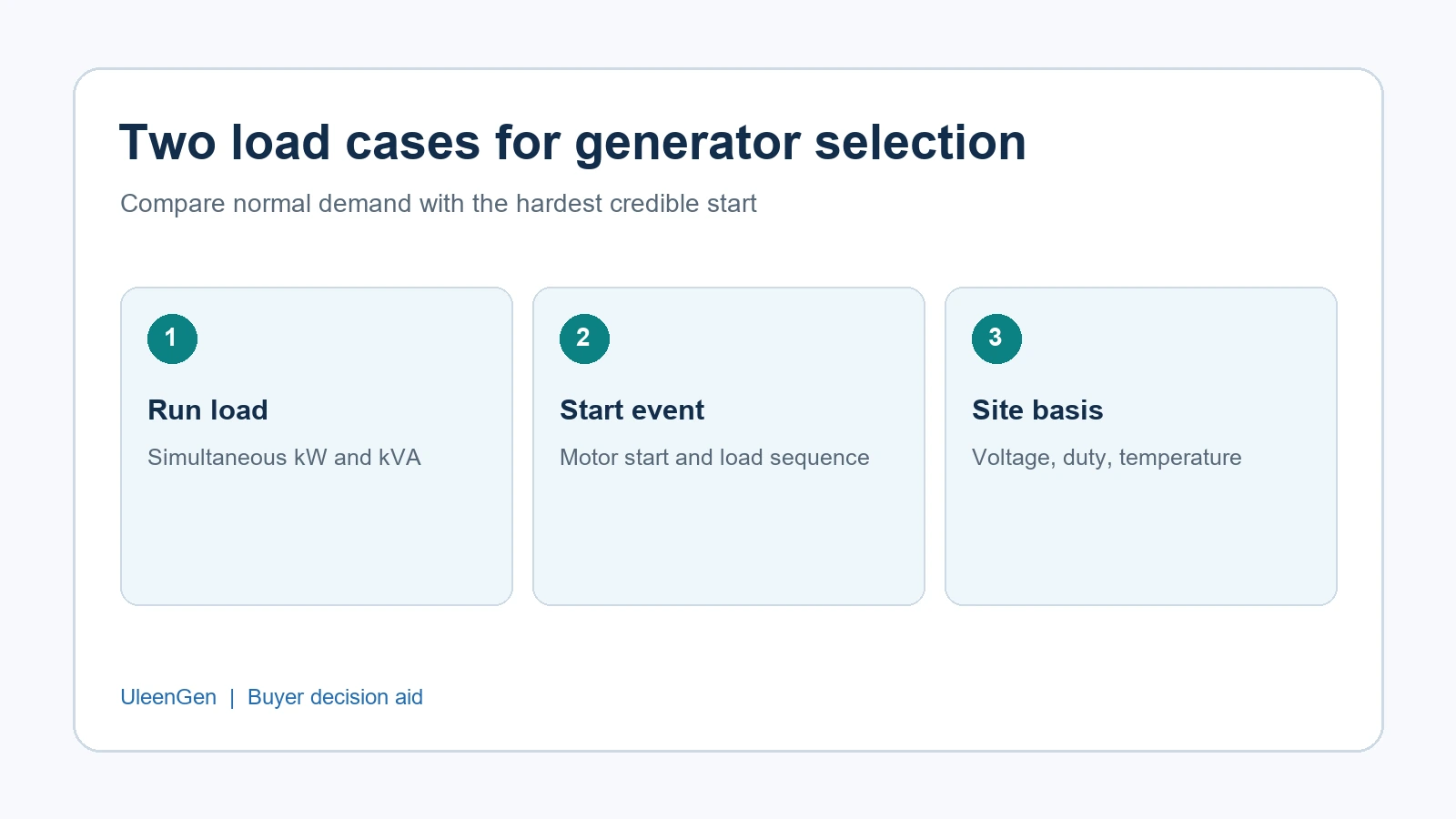
Build two load cases before selecting a size
Take an ordinary hour on generator power. Mark the process equipment that stays on, followed by the pumps, fans, controls and essential building circuits that operate at the same time. Record their kW demand; add kVA and power factor when those values are available. Include voltage and phase. Keep deferrable circuits in a separate column, since they need not return in the first minute of an outage.
The difficult point may last only seconds. A pump starts against the running load, or several drives come back after transfer. For that event, note which motors start, how they start, the order of operation and the permitted voltage dip. Starting current can dominate the selection even when the steady load is modest. Without the sequence, a supplier can check only a total, not the condition the set must survive.
The sequence is part of the equipment specification. Where noncritical circuits can wait, show the delay. Where conveyors and compressors return in stages, give the order and any interlocks. Two sites can have the same running kW but very different restart demands. That difference may change the generator arrangement more than a small change in the steady total.
|
Input to record |
Why it changes the selection |
|
Simultaneous running kW and kVA |
Establishes the continuous electrical demand |
|
Largest motor start and start sequence |
Tests transient voltage and frequency behavior |
|
Loads that can be shed |
May reduce the required starting case |
|
Required voltage, frequency and phase |
Determines whether a quoted model can connect |
|
Annual hours and duty |
Determines which rating may be used |
|
Ambient temperature and altitude |
May change available output and cooling needs |
Compare prime and standby ratings on the same basis
Prime and standby numbers may appear side by side on one datasheet. Circle the one each quotation uses. If one bidder quotes standby output and another quotes prime, the larger printed number does not establish the stronger offer. The RFQ should describe expected hours, load variation and use during outages; each bidder can then identify the rating definition applied to its proposal.
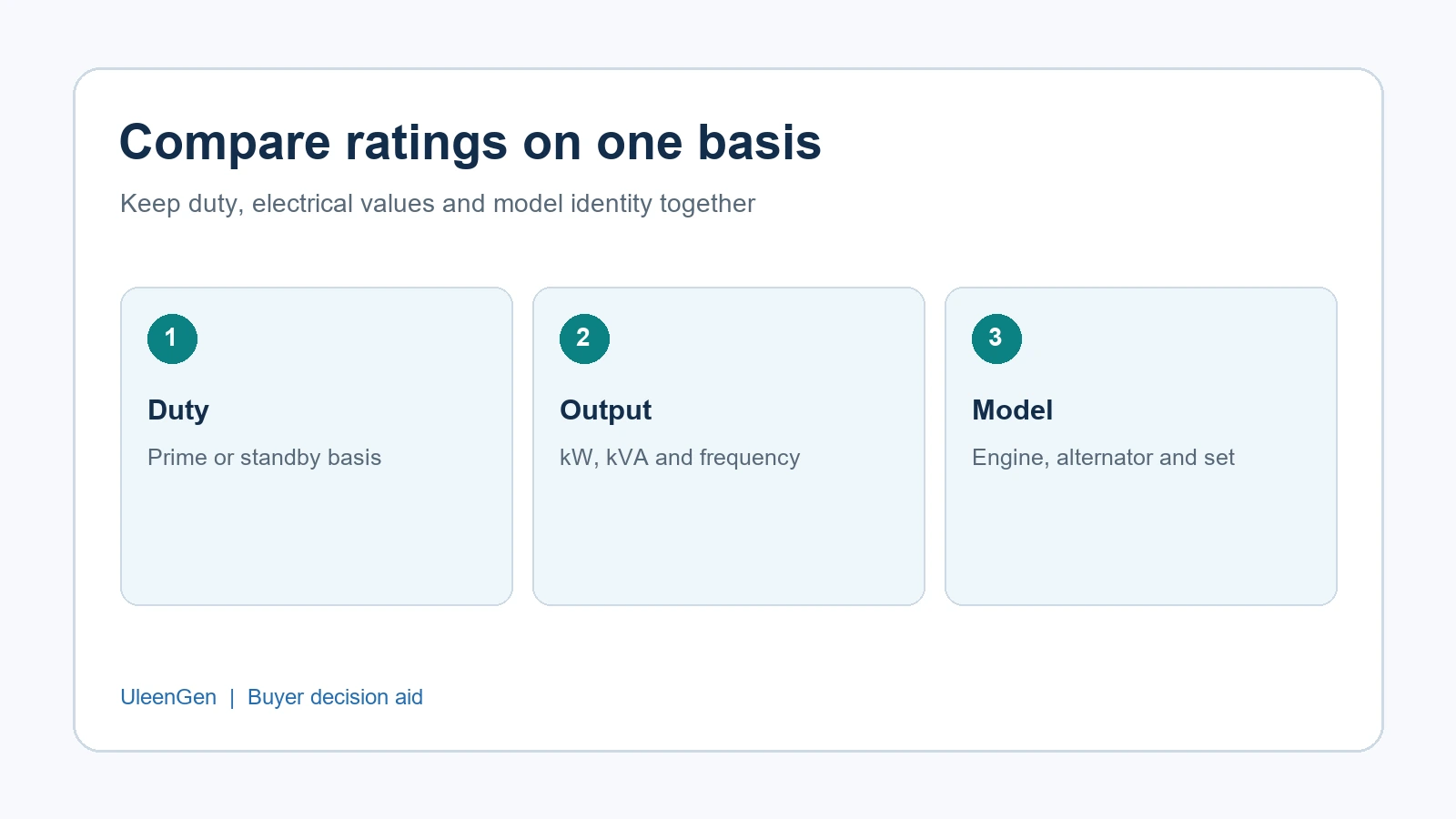
Keep kW beside kVA. At 0.8 power factor, 500 kVA corresponds to 400 kW and 1000 kVA to 800 kW. This conversion catches an obvious mismatch while screening offers. It does not replace the model’s published prime and standby ratings at the required voltage and frequency.
The UleenGen catalog makes the point concrete. Its Perkins UP400GF entry gives 400 kW/500 kVA for prime duty and 440 kW/550 kVA for standby. The UP800GF entry gives 800 kW/1000 kVA prime and 880 kW/1100 kVA standby. Copy only the round kVA number into a spreadsheet and the rating basis disappears. Retain the full model identity and request the current configuration sheet with the offer.
Keep frequency visible on every comparison row. A 50 Hz catalog figure cannot simply be pasted into a 60 Hz project schedule; check the matching model and output first. Phase, voltage and power factor need the same treatment. Our diesel generator buying guide covers the wider RFQ; here the concern is how those fields alter a choice in the 500–1000 kVA band.
Plan for expansion without buying blind spare capacity
“Leave room for expansion” is too loose to price. A planned production line or pump has a likely connection date, running demand and starting event; a possible future building may have none of those yet. Put the known loads on a dated schedule and keep speculative growth on a separate line. That distinction prevents an undefined margin from deciding today’s machine size.
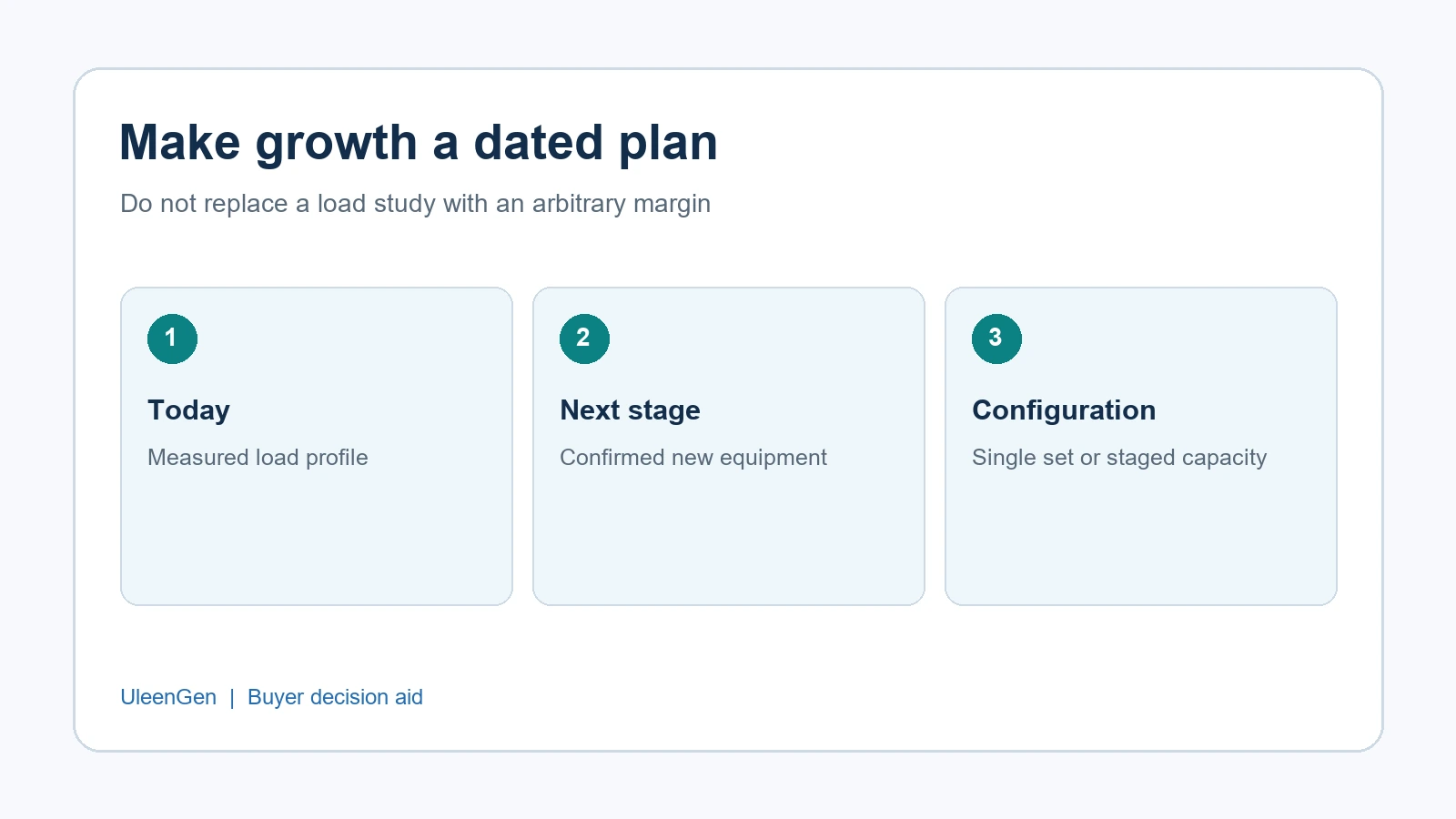
If the added equipment is due soon, one larger set may be a sensible candidate. If growth comes in stages, examine a staged installation or parallel sets as well. The latter choice brings switchgear, controls and maintenance obligations; the former may leave a large machine serving a small load for years. Price and compare the complete arrangement, including space and operational redundancy, before deciding.
A flat spare-capacity percentage cannot answer the starting question. It may cover added running kW but still leave too much voltage dip during a motor start. Equally, a staged restart might remove the event that drove a much larger estimate. Recalculate the actual sequence when the expansion plan changes.
Check the package around the power number
At this power level, a quote needs more than an engine name. Which alternator and controller are supplied? What breaker, fuel arrangement and enclosure are included? Record the component models and exclusions in the comparison sheet. A matching kVA figure can conceal differences in equipment that affect installation and commissioning.
The equipment may fit its plant-room footprint and still fail at the delivery door. Trace the route using finished dimensions and lifting mass, including the turns before the final position. On the installed layout, mark air intake, hot-air discharge, exhaust, cable entry and service access. Those marks should be checked against the model drawing before civil work is fixed.
For outdoor work, request the enclosure drawing and the conditions used for any noise figure. “Silent” alone is not a measurable acceptance criterion. Automatic transfer needs an ATS and control interface in scope; parallel sets need a synchronization and protection design. The bus arrangement cannot be inferred from their kVA labels.
Fuel data should name the load point at which it was measured. A variable-load site will not consume fuel as though the set ran at one catalog point all day. Pair the quoted model’s consumption data with usable tank capacity and the expected operating profile. That gives a defensible runtime estimate for the same load cases used in selection.
Use a comparison sheet that exposes open assumptions
Before ranking prices, mark what each offer actually buys. Enclosure, ATS, tank, commissioning and test records are easy to assume and expensive to discover missing later. Check duty rating and frequency on the same sheet. Where an item is blank, ask for a written answer and keep the bid open until it arrives.
|
Comparison field |
What the written offer should identify |
|
Duty and output |
Prime and standby kW/kVA, rating basis and reference conditions |
|
Electrical match |
Voltage, frequency, phase, power factor and breaker |
|
Dynamic behavior |
Largest start, load steps and acceptable voltage dip |
|
Named components |
Engine, alternator, controller and protection equipment |
|
Site package |
Enclosure, airflow, exhaust, tank, footprint and weight |
|
Evidence |
Datasheet, outline drawing, wiring diagram and agreed load test |
|
Future stage |
Expansion load, switchgear provision and parallel option if needed |
Our generator ranges by engine provide candidate families once the electrical brief is settled. From there, the useful comparison is between named configurations and their supporting documents.
Put the unresolved inputs on the inquiry form
The inquiry should carry both load cases, the duty and expected annual hours, electrical values, site conditions and dated expansion loads. Attach the drawings and tests the project expects. Some fields may still be open. Name them rather than guessing: the supplier can then state which part of its recommendation depends on an assumption.
Send that schedule through our generator project inquiry form. We can use it to identify a configuration for technical comparison. The purchase decision should then reference the selected datasheet, the installation design and the agreed acceptance test, with open assumptions resolved in writing.


