



contact us
-
3-2-1003 Software park, Weifang Hi-tech Zone, Shandong, China
- +8615095247272
- sales@uleengen.com
-


A Factory Visit by a Tunisian Client: Air-Cooled Deutz Generator Sets


A Factory Visit: Air-Cooled Deutz Generator Sets
When selecting diesel generator sets, customers often weigh the pros and cons of water-cooled generators and air-cooled generators. Upon entering the assembly workshop for air-cooled Deutz generator sets, the Tunisian clients were greeted by rows of engines—each featuring cylinder blocks covered in dense cooling fins, and notably lacking radiators or complex plumbing. The purpose of the visit was clear: to see firsthand why air-cooled Deutz diesel engines excellent in harsh environments—such as high-altitude, frigid, or water-scarce regions—and to determine whether they warrant a purchase.
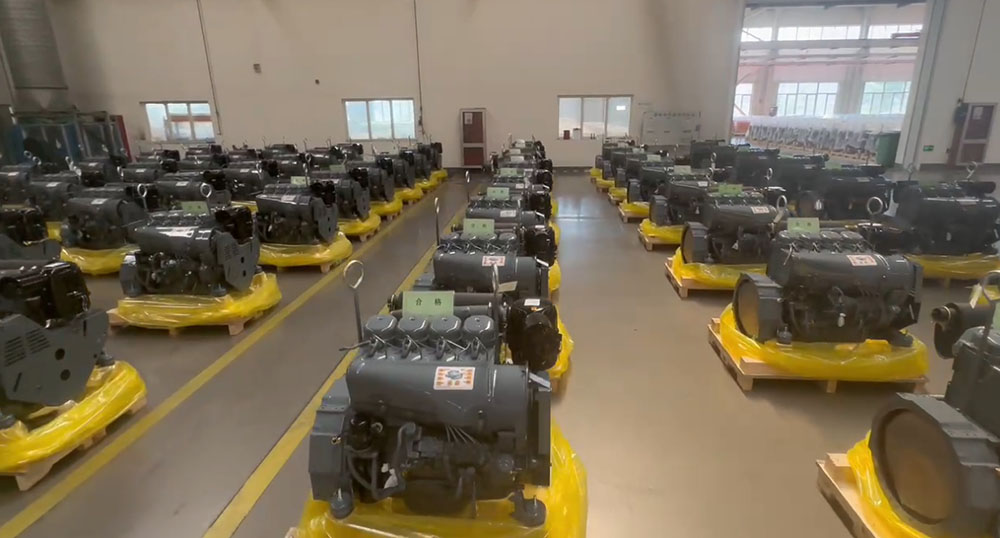
Simplifying the Design to Enhance Reliability
The first stop was the assembly line. Air-cooled Deutz diesel engines eliminate water pumps, coolant pipes, and radiators; the cylinder blocks and heads are designed as separate components, with no cooling water jackets. This effectively removes the most common failure points found in water-cooled systems—such as leaks, freeze-related cracks, or blockages caused by scale buildup.
“A significant portion of failures in water-cooled generator sets originates within the cooling system itself,” the on-site engineer explained. Air-cooled engines rely on forced airflow directed over cooling fins on the cylinder blocks and heads. By drastically reducing the number of components, the failure rate is lowered. Comparative data indicates that air-cooled diesel engines have a failure rate approximately 27% lower than their water-cooled counterparts, with mechanical wear reduced by half. For backup power applications that require long periods of unattended operation, every eliminated failure point translates to a lower risk of power outages.
Meeting the Demands of Extreme Environments
Some of the visiting clients operate in high-altitude regions year-round, making them particularly concerned about cold-weather starting and issues related to boiling points. During the tour, a cold-start demonstration was conducted on a test bench. In an environment simulated at -35°C, the unit started successfully on the first attempt and ran smoothly. This is due to the air-cooled engine’s ability to reach higher cylinder-wall temperatures quickly, further supported by an integrated air heater.
In high-altitude regions, a major challenge is the reduction in the boiling point of water. Water-cooled generator sets are prone to “boiling over” at high altitudes. In contrast, air-cooled units require no water at all; with cylinder head temperatures reaching an average of 170°C, they remain entirely unaffected by the impact of atmospheric pressure on boiling points. From frigid regions as cold as -40°C to scorching environments reaching 50°C, air-cooled Deutz generator sets maintain a stable power output. For projects in remote locations—such as oil fields, mines, or telecommunications base stations—where water access is often difficult, eliminating the need for cooling water replenishment translates into significant operational cost savings.
Air cooled Deutz diesel generator specification
| Genset Model | 50HZ | Diesel Engine | Alternator | Overall Size (mm) | Gross Weight (kg) | ||||||
| Power (kW) | Power (kVA) | Model | Rated Power (kW) | No. of Cylinder | Bore xStroke (mm) | Displacement (L) | Rated Fuel Consumption (L/h) | Model | |||
| UD15GF | 12 | 15 | F2L912 | 14 | 2 | 100*120 | 1.88 | 3.1 | 164D | 1400×800×1100 | 500 |
| UD20GF | 16 | 20 | F3L912 | 24 | 3 | 100*120 | 2.828 | 4.1 | 184ES | 1700×800×1100 | 700 |
| UD25GF | 20 | 25 | F3L912 | 24 | 3 | 100*120 | 2.828 | 5.2 | 184FS | 1700×800×1100 | 700 |
| UD30GF | 24 | 30 | F4L912 | 32 | 4 | 100*120 | 3.77 | 6.2 | 184G | 1900×800×1150 | 900 |
| UD38GF | 30 | 37.5 | F4L913 | 34 | 4 | 102*120 | 4.086 | 7.7 | 184H | 2000×800×1150 | 930 |
| UD50GF | 40 | 50 | F6L912 | 48 | 6 | 100*120 | 5.655 | 9.8 | 224D | 2250×800×1350 | 1150 |
| UD60GF | 48 | 60 | F6L912T | 61 | 6 | 100*120 | 5.655 | 11.8 | 224E | 2250×800×1350 | 1200 |
| UD100GF | 80 | 100 | BF6L913 | 88 | 6 | 102*125 | 6.128 | 19.6 | 274C | 2500×800×1350 | 1450 |
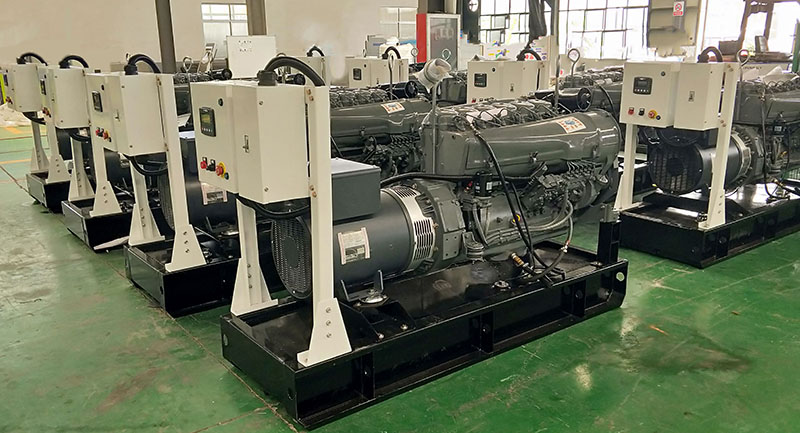
Purchasing Decision: Reliability Through Suitability
As the tour neared its end, the client sat in a conference room, reviewing the technical specification sheet for a final confirmation. The advantages of air-cooled Deutz diesel engines are clear: a simple design that ensures a low failure rate, excellent environmental adaptability due to the absence of cooling water, and a long service life resulting from reduced wear. Their limitations are equally well-defined—constrained by the efficiency of air-based heat exchange, these units generally offer lower power outputs, making them better suited for small-to-medium power applications where reliability is prioritized over power density.
The client ultimately placed an order. The reasoning was straightforward: Tunisia, located along the Mediterranean coast of North Africa, features the vast Sahara Desert in its south and faces overall water scarcity. By using air as the cooling medium—dispensing with radiators and coolant entirely—these air-cooled diesel engines offer a simple, easy-to-maintain design that is exceptionally well-suited for hot, water-deprived environments. Furthermore, because the cooling fins on an air-cooled engine operate at high temperatures, there is a significant thermal gradient between the engine and the ambient air; this makes the units insensitive to fluctuations in external temperature, preventing them from overheating in extreme heat or overcooling in cold weather. With an air-cooled Deutz unit, one simply fills the tank with fuel and starts the engine—no need to worry about coolant at all. This is the true value of a factory visit: structural details not captured on a specification sheet become immediately apparent on the shop floor, and promises regarding reliability become tangible and convincing amidst the roar of the test bench.


