



Contacta con nosotros
-
3-2-1003 Parque de software, zona de alta tecnología de Weifang, Shandong, China
- +8615095247272
- sales@uleengen.com
-


Marine Generators in Harsh Sea Conditions: What Buyers Should Check


Imagine the set installed and the machinery room full. The seawater strainer now needs cleaning. Is there room to withdraw its basket, or does another item block it? What happens to the cable entries when the compartment is washed down? A rating sheet cannot answer either question. The vessel’s motion and the interval to the next port call make them consequential.
Write down the vessel type, route, running hours and loads that cannot be lost. Add the conditions around the proposed installation. The checklist below turns that brief into questions for the supplier. Our Cummins marine generator range provides candidate sets, but the offered model needs to be checked against this vessel’s own requirements.
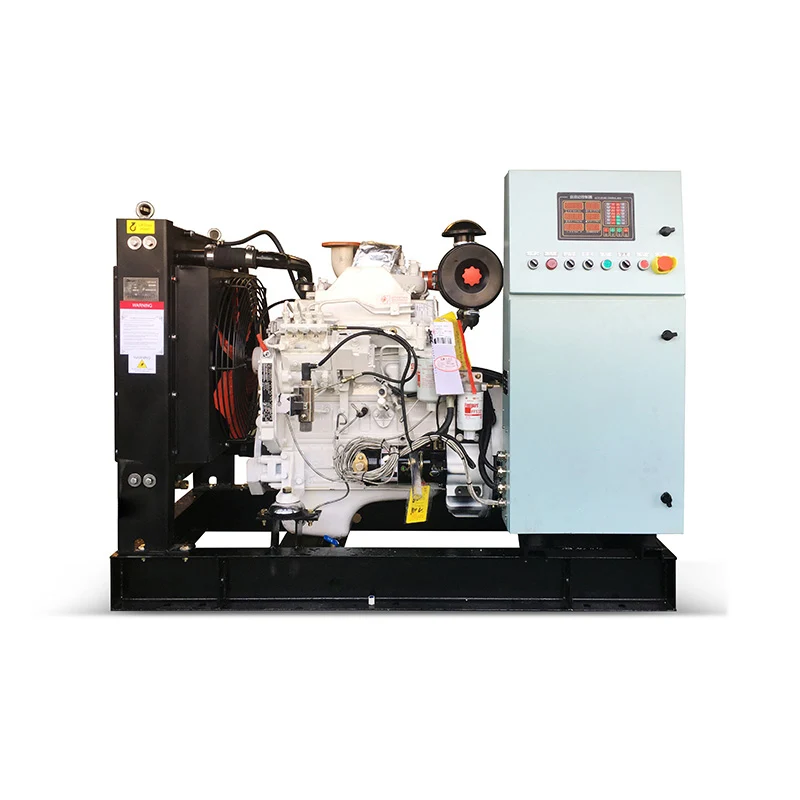
Define the sea conditions in the inquiry
Consider the inspection window first. A coastal workboat might return frequently but see repeated spray. An offshore service vessel could run longer before a technician can reach it. Fishing work adds wet compartments and refrigeration demand. Which of those patterns describes the intended vessel? Spell it out in the inquiry. The words “harsh conditions” are too open to guide an equipment offer.
The supplier needs a sketch of the actual compartment, even at inquiry stage. Mark the proposed location and available air route. Add expected temperature, seawater source and the likely direction of spray. In the operating brief, identify hours of use and the circuits retained after another source fails. If maintenance must wait until port, put that constraint beside the space sketch; it affects what can be serviced on board.
Keep main and emergency duties distinct in the brief. A set serving daily hotel or deck loads is used differently from one reserved for emergencies. The vessel designer or relevant authority should establish the required arrangement and approvals. The quotation can then identify the duty it actually covers.
Trace seawater from intake to discharge
The phrase “seawater heat exchanger” leaves most of the yard connection work unnamed. On the offered drawing, trace the intake to the strainer, pump, exchanger and overboard discharge. Trace the engine-coolant loop on a separate line. At a boundary with yard pipework, write down the valve, hose or pipe specification and connection size. Any gap on the drawing needs an answer before installation.
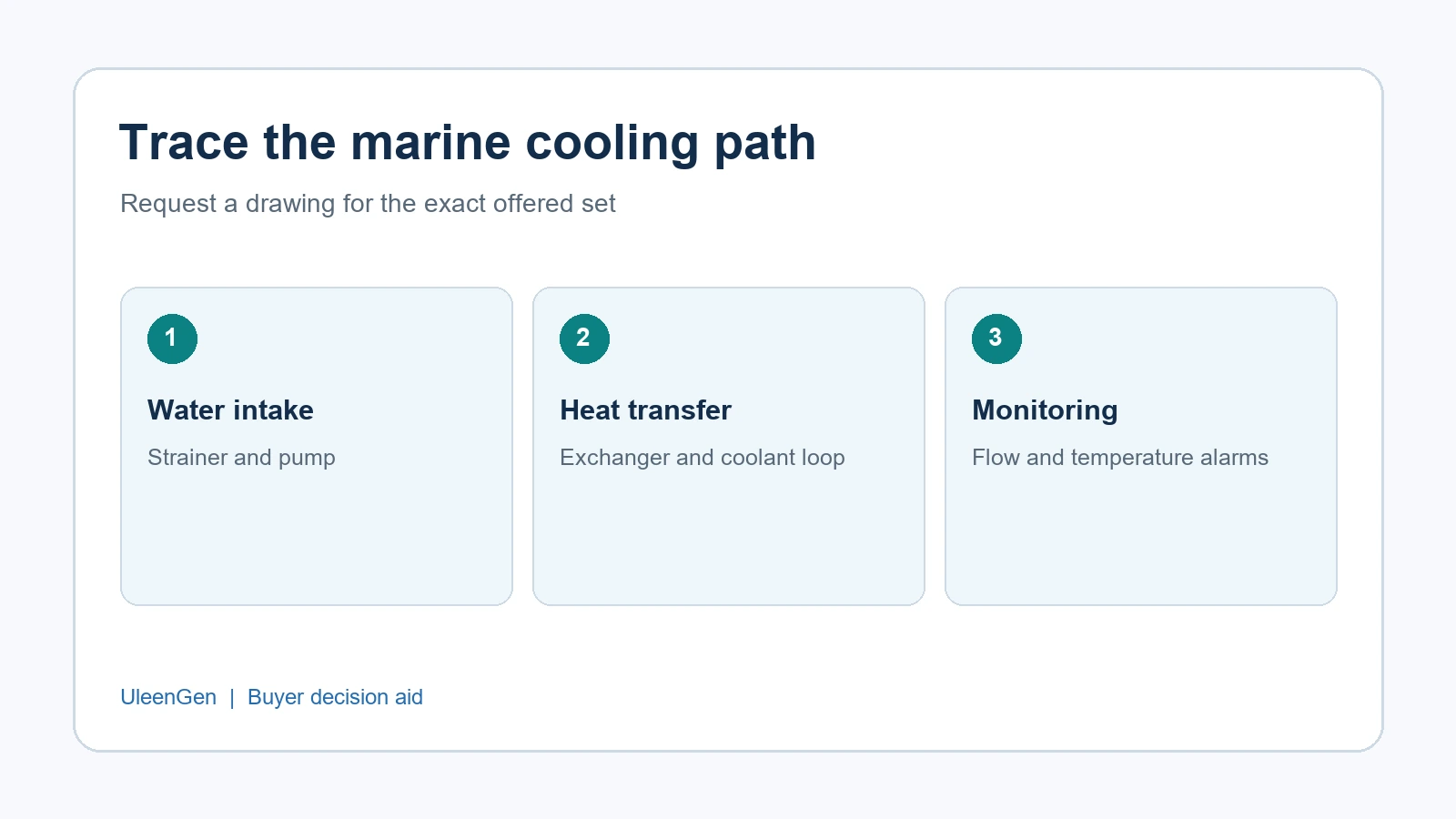
Strainers collect more than salt. Sediment or growth can build up on the route. The yard layout should show a clear path for removing the basket and opening the exchanger after neighboring machinery is in place. The alarm schedule should say what signals a flow problem or high temperature and what the crew should do next. The water encountered on the route will shape the inspection interval.
The seawater circuit is not the whole cooling design. Heat from the alternator and nearby machines remains in the room. Check the model’s heat-rejection data against the yard’s intake and discharge arrangement. If hot air has no clear exit, room temperature can rise while seawater flow remains normal. This is a layout issue to settle before the set is boxed in.
El Weichai marine generator range also uses a seawater heat-exchanger description. That shared phrase says little about materials, required flow or room to service each model. Compare current drawings for the specific sets under consideration.
Find the places salt and water can enter
Fresh paint can hide the corrosion questions that matter later. At quotation review, look closely at cable glands, exposed fixings, cabinet seams and the mounting hardware. Request the material or treatment used at those locations, on the offered set rather than a generic series. Check the deck drain route too. Wash water left beside the base frame changes the exposure after installation.
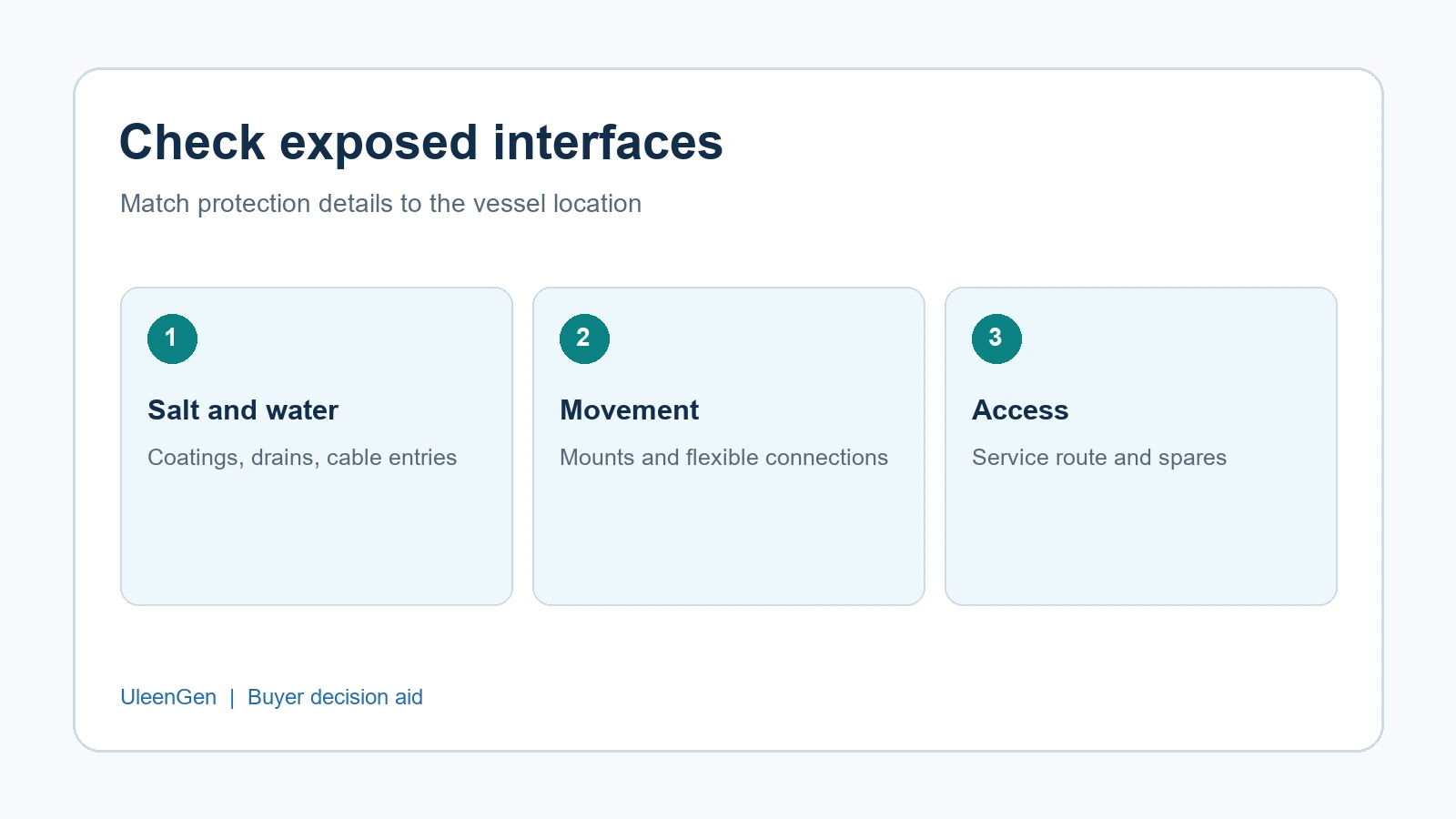
Where will spray land? Where does condensation collect, and how is the compartment washed? Those observations matter for the alternator and control panel, particularly around openings and cable entries. Compare their component-level protection documents with their positions on the yard drawing. A product-range brochure rarely describes that exact exposure.
Coatings do not end the maintenance discussion. Crews need access to inspect and clean exposed surfaces. If the selected cooling package has sacrificial or replaceable items, show their positions and removal space. Decide which tasks can be done at sea and which belong to shore service. The spares list should follow that division.
Check movement, mounting and electrical stability
Mounts have a job beyond reducing noise. They allow the set to move relative to the vessel structure, and the connected hoses and cables must suit that movement. The outline drawing should give weight, fixing points and lifting details. Centre-of-gravity data, where available, helps the yard assess the foundation and handling plan. Review the flexible connections against the selected mount arrangement.
On the electrical one-line diagram, mark the bus voltage, frequency, phase and power factor. Then mark the pumps, refrigeration units and deck machines whose starts might coincide. Where shore power or another set joins the bus, show how switching and protection are intended to work. That diagram may rule out a set that otherwise fits the available space.
Noise heard in a crew space may come through the structure rather than through the air around the engine. Request the conditions behind any quoted noise figure. Review mounts, exhaust supports and the enclosure on the vessel layout, including the space left for servicing. The enclosure alone will not resolve a vibration path through the foundation.
For a deeper discussion of onboard load lists and starting demand, see our marine generator sizing guide. This procurement check adds environmental and installation evidence to that electrical sizing work.
Verify approval and document scope before comparing prices
Ask the owner or yard which approval documents are required before treating “marine certified” as a specification. The reviewing authority may distinguish the engine, alternator, assembled generating set and controls. Put each required document in a list alongside what the bidder can supply. Missing scope becomes visible while the quotation is still negotiable.
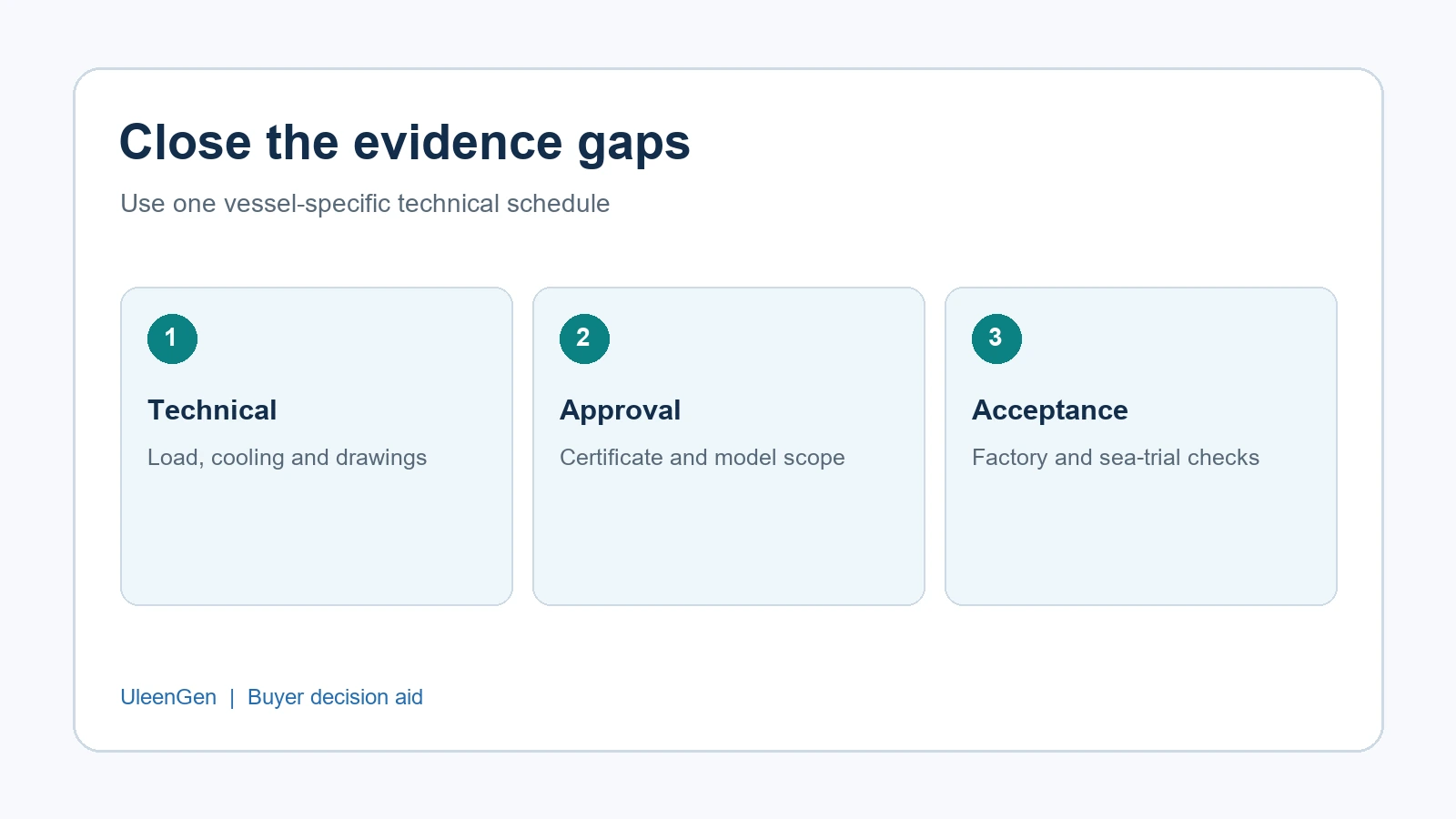
A family-page certificate is a reference, not the final answer. Compare its model designation, frequency and approval scope with the offered configuration. Record required inspections and test reports in the purchase order. A document mismatch found after delivery can delay the vessel’s approval.
The order should describe the factory test before production is complete: output, voltage, frequency, load stages, alarms, shutdowns and records. That test checks the supplied package under factory conditions. Once installed, the connected seawater circuit, air route, mounts and control interfaces need their own checks with the yard. Keep those sea-trial and commissioning checks in a separate plan.
An alarm at sea is a poor time to discover that the manual covers several controllers. Record the installed engine, alternator, controller, seawater pump and exchanger by model. Match the manuals and spare-part numbers to what was fitted. Decide which consumables the crew will carry, based on service intervals and the route, rather than copying a generic spare-parts list.
The last unresolved connection is often at the boundary between suppliers. On the approved drawing, give each fuel, cooling, exhaust, power cable and alarm interface an owner. Review the list with the yard and generator supplier before installation closes access. A short responsibility table makes missing work visible before commissioning day.
|
Buyer check |
Evidence to request |
|
Vessel duty and electrical system |
Load list, rating basis, voltage, frequency and phase |
|
Cooling |
Circuit drawing, flow requirement, strainer and heat-exchanger access |
|
Corrosion and water exposure |
Materials, coatings, electrical protection and installation limits |
|
Mounting |
Outline drawing, weight, fixing points and vibration-isolation details |
|
Service at sea |
Alarm list, consumables, spare parts and access dimensions |
|
Approval |
Certificate scope, model identity, test report and required inspections |
Decide with a vessel-specific technical schedule
Send one schedule to every bidder, with route and duty, loads, compartment conditions, cooling and exhaust interfaces, approval documents and service clearances. An unanswered field should stay marked open. Compare prices once the written offers describe the same boundaries.
Our Yuchai marine generator range provides another family to examine against that schedule. Send the vessel details and required document scope through our marine generator inquiry page. We can then identify a specific configuration for review with the shipyard and the relevant approving authority.


