



联系我们
-
中国山东省潍坊市高新区软件园3-2-1003
- +8615095247272
- sales@uleengen.com
-


What Is the Difference Between Silent and Super Silent Generators


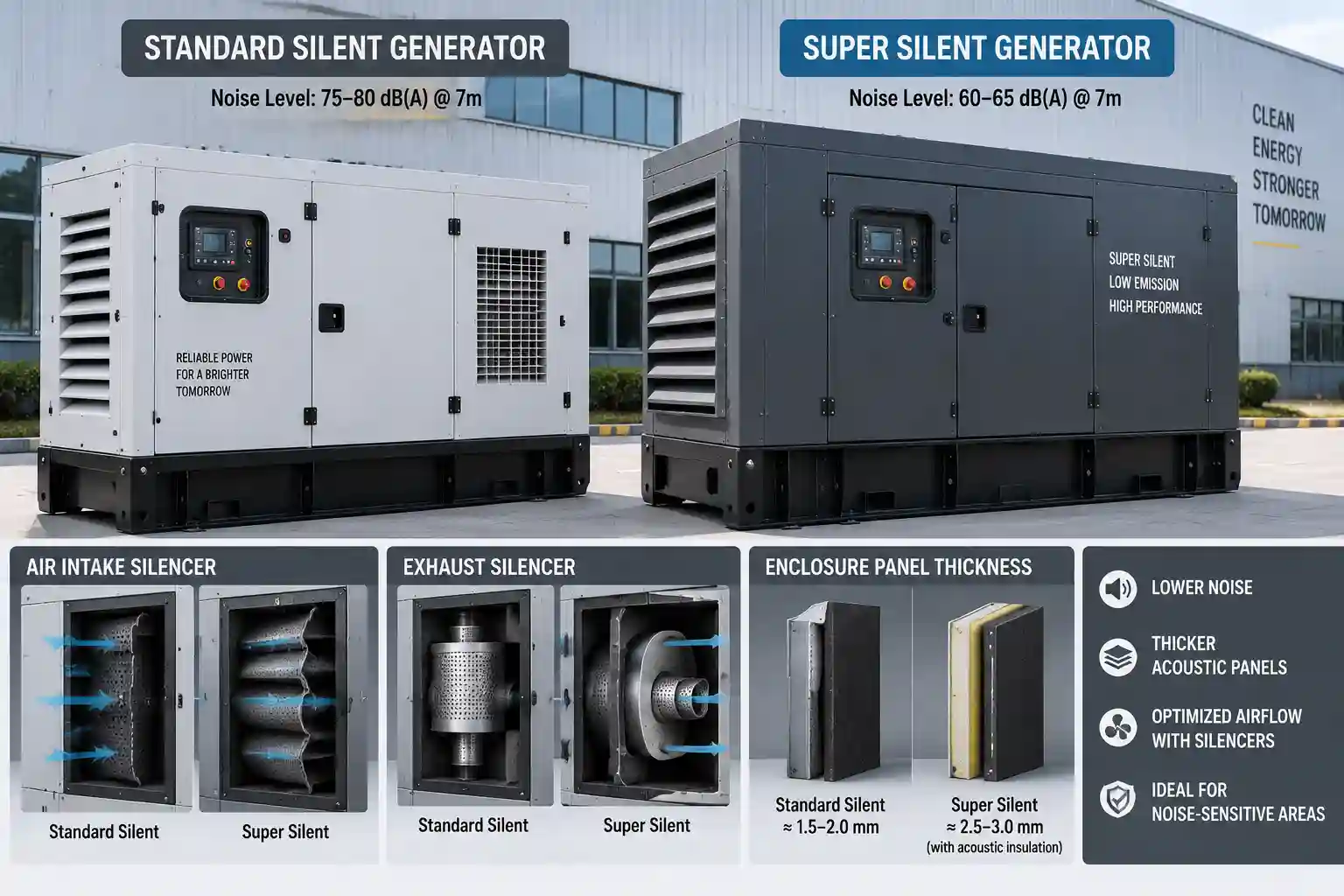
Silent and super silent generators use acoustic enclosures to control engine, exhaust, cooling, and vibration noise. A silent generator provides a standard sound-attenuating enclosure for industrial, construction, commercial, and temporary-power work. A super silent generator applies a more intensive acoustic design for projects located close to occupied buildings or public areas.
The label gives you a product category. The technical data supports the purchase decision.
For a useful comparison, review the generator model, engine configuration, frequency, load condition, measurement distance, enclosure design, airflow path, and exhaust arrangement.
What Are Silent and Super Silent Generators?
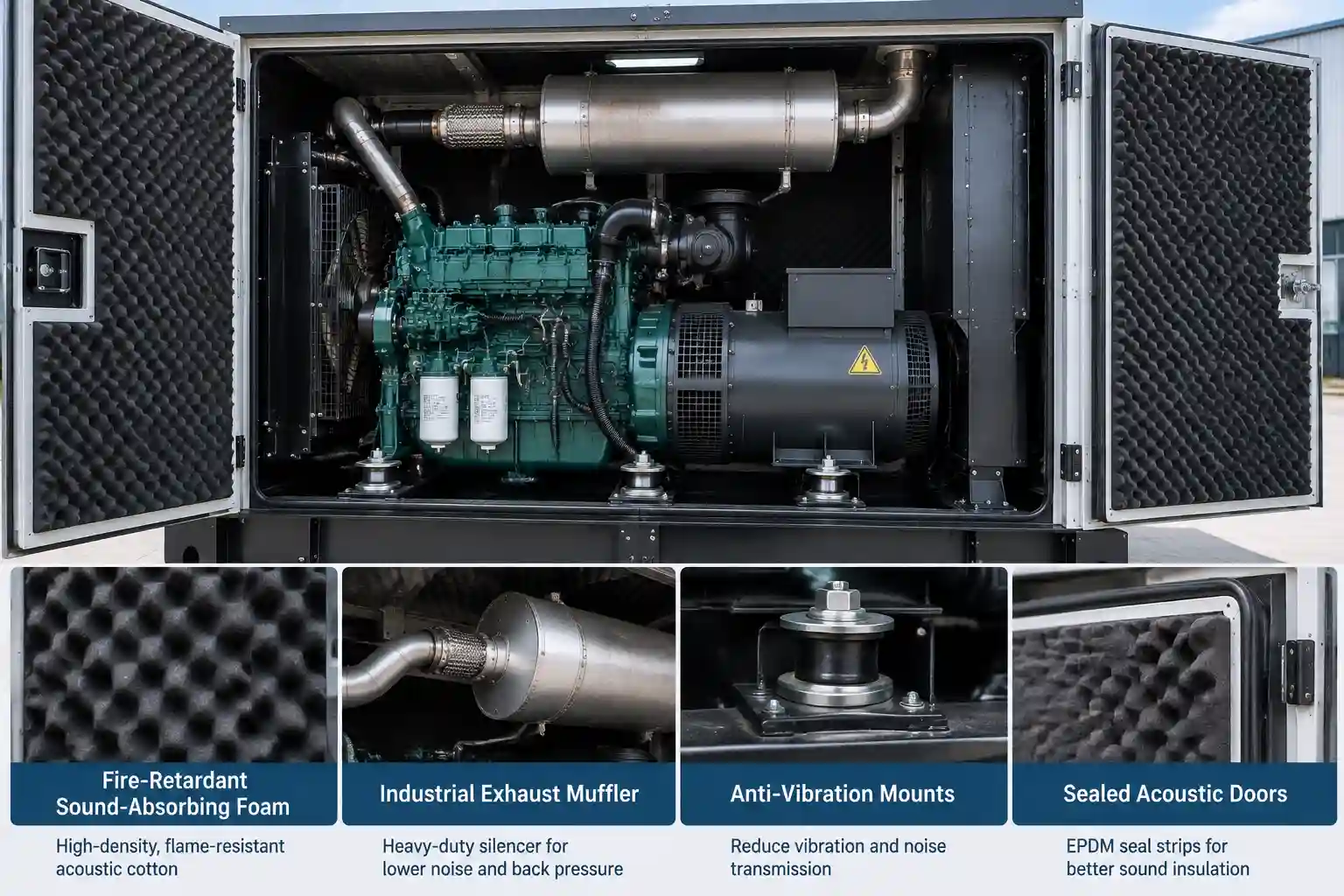
A silent generator set places the engine, alternator, control equipment, and exhaust components inside an acoustic enclosure. The enclosure contains sound, guides cooling air, and protects internal components from the outdoor environment.
A super silent generator uses the same basic enclosure concept with additional acoustic treatment. The design may include more sound-absorbing material, longer intake and discharge paths, enhanced exhaust silencing, or stronger vibration isolation.
Manufacturers use these terms as product descriptions. The technical specification for the exact model remains the applicable reference.
What Is a Silent Generator?
A silent generator uses a sound-attenuating enclosure around the complete generating set. The enclosure reduces direct engine noise and controls the route taken by intake air, radiator air, and exhaust gases.
The cabinet has to support cooling and service access as well as noise control. Air openings require enough capacity for radiator airflow. Doors and panels require practical access for inspection, maintenance, and fault handling.
The article What Is a Silent Diesel Generator? provides additional background on the enclosure and operating principle.
Main Design Features
A silent generator may include:
-
Acoustic steel panels
-
Sound-absorbing lining
-
An exhaust muffler
-
Controlled air inlet and outlet channels
-
Radiator airflow management
-
Anti-vibration mounts
-
Lockable service doors
-
Protected control-panel access
-
Emergency-stop access
-
Lifting and transport points
The exact layout depends on generator output, engine model, radiator arrangement, and enclosure dimensions. A compact generator and a large industrial generator require different airflow and service solutions.
Maintenance access deserves attention during quotation review. Technicians need a practical route to filters, batteries, control components, and other service points. A cabinet specification should identify both acoustic treatment and access arrangements.
Typical Applications
Silent generators are commonly considered for:
-
Construction sites
-
Temporary power projects
-
Industrial facilities
-
商业建筑
-
Agricultural operations
-
Outdoor events
-
Backup power installations
They suit sites where people work near the equipment and where the project requires controlled operating noise.
What Is a Super Silent Generator?
A super silent generator uses additional acoustic treatment across the enclosure, exhaust path, airflow openings, and vibration-control system. The design aims to control the sound that reaches nearby people and buildings.
The acoustic design becomes more complex as generator output increases. A larger engine requires more cooling air and a larger exhaust system. Those requirements influence the size, shape, lining, and airflow channels of the enclosure.
How Does a Super Silent Design Control Noise?
A super silent configuration may use:
-
Additional acoustic lining
-
Higher-performance enclosure panels
-
Extended intake and discharge channels
-
Air silencers
-
A higher-performance exhaust muffler
-
Enhanced vibration isolation
-
A revised radiator and fan arrangement
-
Sealed or reinforced access-panel interfaces
Each element contributes to the complete result. The exhaust muffler addresses exhaust sound. The airflow channels address fan and radiator noise. Vibration mounts address mechanical transmission through the frame and base.
Ask the supplier to identify the measured noise value, unit, test distance, load condition, frequency, and test method for the exact generator model.
Typical Applications
Super silent generators are often considered for:
-
医院
-
Hotels
-
Schools
-
Residential developments
-
Offices
-
Retail properties
-
Events near audiences
-
Night-time operating projects
The site requirement should guide the enclosure selection. A project near occupied rooms may require acoustic test documentation and a defined acceptance condition.
How Do Silent and Super Silent Generators Compare?
The categories describe different levels of acoustic treatment and different site priorities.
| Factor | Silent Generator | Super Silent Generator |
|---|---|---|
| Acoustic treatment | Standard sound-attenuating enclosure | Additional enclosure, airflow, exhaust, and vibration treatment |
| Typical site | Industrial, construction, commercial, and temporary-power locations | Hospitals, hotels, residences, schools, offices, and public areas |
| Main review point | Noise value, cooling, enclosure, and service access | Noise value, test conditions, cooling, enclosure, and service access |
| Operating schedule | Daytime or standard operating periods | Projects with closer proximity or night operation |
| Selection inputs | Site distance, operating hours, and load | Noise limit, distance, load, schedule, and test basis |
The exact engine, alternator, radiator, exhaust system, and cabinet configuration influence the measured result. Compare complete generator sets with matching test conditions.
Is a Super Silent Generator Always Quieter?
A super silent label describes the acoustic treatment selected by the manufacturer. A measured specification is required for a direct model comparison.
Request these fields in the quotation:
-
Noise value and unit
-
Sound pressure or sound power basis
-
Measurement distance
-
Load condition
-
频率
-
Prime or standby rating
-
Measurement direction
-
Test method
-
Enclosure configuration
-
Cooling and exhaust arrangement
Sound pressure level describes sound measured at a receiving position. Sound power level describes the acoustic energy emitted by the source. The two values use different measurement bases.
Load also affects the result. Engine combustion, exhaust flow, radiator-fan operation, and vibration can change as the electrical load changes. A catalog result usually applies to a defined test condition.
What Affects Generator Noise During Operation?
The enclosure category forms one part of the noise assessment. The generator configuration and installation environment influence the sound level experienced by nearby people.
Engine Speed and Frequency
The required frequency and electrical configuration determine the applicable generator specification. A 50 Hz set and a 60 Hz set may use different operating arrangements.
State frequency, phase, engine model, and generator-set model in the RFQ. The noise data should apply to that same configuration.
Load Level
Operating load influences combustion, exhaust flow, cooling demand, and fan operation. A variable-load project needs information that reflects the expected operating range.
Include the planned load profile in the technical inquiry. A single rated-load value provides only one defined operating point.
Exhaust and Cooling Airflow
The exhaust outlet and radiator fan can contribute to the sound heard at the site. The enclosure must provide sufficient cooling airflow while guiding sound away from occupied areas.
Review the exhaust silencer, intake opening, discharge opening, fan arrangement, and installation orientation. These details become important when the generator operates near buildings.
Installation Distance and Surface
Distance affects the sound level at the receiving point. Walls, nearby structures, ground surfaces, and reflective areas also influence the result.
Provide the installation position, surrounding structures, and operating schedule during quotation review. A generator operating near bedrooms or patient rooms requires a site-specific assessment.
How Should Buyers Compare Noise Specifications?
Use one comparison basis for every supplier. Record the noise value, unit, measurement distance, load condition, frequency, duty rating, test method, enclosure type, cooling arrangement, and exhaust configuration.
Confirm that the data applies to the complete generator set. Engine-only data and enclosure-only claims describe separate components.
这 Cummins Series Diesel Generator range offers one product reference for review. The quotation should identify the exact model and its matching acoustic data.
Which Generator Type Fits the Project?
Silent Generator Selection
A silent generator may fit a project with:
-
A site separated from occupied buildings
-
Mainly daytime operation
-
Moderate noise requirements
-
Standard acoustic-control needs
-
Clear model-specific noise data
-
High priority on transport and service access
This configuration supports many industrial, construction, temporary-power, and commercial applications.
Super Silent Generator Selection
A super silent generator may fit a project with:
-
Installation close to homes, offices, hotels, or public areas
-
Evening or overnight operation
-
A defined site noise limit
-
An owner requirement for acoustic documentation
-
People working or living close to the equipment
-
Reflective walls or confined installation spaces
A higher acoustic specification can affect cabinet size, airflow design, exhaust routing, service access, and installation planning. Include these items in the technical comparison.
For additional engine-set references, review the Deutz Series Diesel Generator 和 SDEC Series Diesel Generator ranges, then request model-specific noise information.
What Should Be Included in a Generator RFQ?
A complete RFQ should state:
-
Prime power in kW and kVA
-
Standby power in kW and kVA
-
50 Hz or 60 Hz
-
Single-phase or three-phase configuration
-
Engine and generator-set model
-
Required noise limit
-
Measurement distance
-
Expected load condition
-
Daytime or night-time operation
-
Installation location
-
Enclosure requirements
-
Exhaust arrangement
-
Cooling and ventilation conditions
-
Service-access requirements
-
Acoustic test documentation
State whether the noise value forms part of the acceptance criteria. The supplier can then match the enclosure, cooling system, exhaust arrangement, and documentation to the project requirement.
Common Purchasing Mistakes
Using Product Names as Noise Data
“Silent” and “super silent” describe enclosure categories. A quotation still needs measured noise data for the offered model.
Combining Incompatible Test Results
Noise values measured at different distances, loads, frequencies, or methods use different bases. Place the required test condition in the RFQ.
Reviewing the Exhaust and Ignoring the Fan
The exhaust system receives attention during many reviews. The radiator fan and airflow openings also contribute to operating sound.
Accepting an Enclosure With Limited Service Access
Acoustic panels and service doors need to support inspection and repair. Record the required service clearances before approving the cabinet design.
Treating Noise Control as a Separate Performance Item
Acoustic treatment works together with cooling airflow, exhaust discharge, vibration isolation, and electrical loading. Review the complete configuration.
Conclusion: Match Noise Control to the Site
Silent and super silent generators serve different acoustic requirements. A silent configuration supports general industrial and temporary-power work. A super silent configuration supports projects near occupied areas, public spaces, or night-time operating locations.
The purchase decision should use measured noise data, test conditions, installation distance, operating schedule, load, cooling arrangement, exhaust design, and service access. Product names provide the initial classification. The exact model specification supports approval.
Shandong Uleen Generator Co., Ltd. supplies generator-set configurations for industrial, commercial, and temporary-power applications. During quotation review, submit the required output, frequency, phase, operating schedule, installation location, noise limit, and acceptance documents. The supplier can then confirm the applicable enclosure and generator configuration.
常见问题解答
Q1: What is the main difference between a silent and super silent generator?
A: A super silent generator uses additional acoustic treatment across the enclosure, airflow path, exhaust system, or vibration-control structure. The exact design depends on the generator model and project requirement.
Q2: Is a super silent generator always quieter?
A: A super silent label identifies a higher level of acoustic treatment. Compare the measured value, unit, test distance, load, frequency, and test method for a reliable result.
Q3: Which generator type fits a residential-area project?
A: A super silent configuration may fit a residential-area project when the generator operates close to homes or during night hours. The selection should follow the site noise limit and the supplier’s model-specific test data.
Q4: What noise data belongs in a generator quotation?
A: Request the noise value, unit, measurement distance, load condition, frequency, duty rating, test method, enclosure configuration, cooling arrangement, and exhaust arrangement. These fields give each supplier the same technical basis.
Q5: Can a silent generator operate near a hospital or hotel overnight?
A: The project needs a site-specific noise review before approval. Confirm the required noise limit, operating schedule, installation distance, load condition, enclosure design, and acoustic test documentation.


