
新闻
新闻 行业新闻 How to Choose the Right Marine Generator Size for Your Vessel

目录

    How to Choose the Right Marine Generator Size for Your Vessel

    2026-04-24 00:00:42
    通过管理员
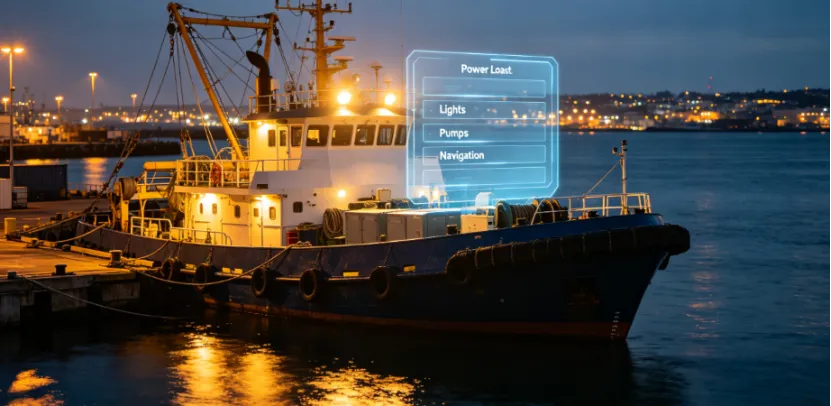
    Blue workboat at lit dock with glowing conceptual Power Load overlay.

    If you are shopping for a marine diesel generator, the sizing question comes first, even before price. Too small, and the genset struggles when pumps, refrigeration, or air conditioning start at the same time. Too large, and you pay more up front, burn fuel at a poor load point, and invite low-load issues that nobody enjoys dealing with later. That is why marine generator sizing matters so much.

    A quick note on supplier choice. UleenGen is a Shandong-based generator manufacturer that has been in this field since 2011 and provides technical consultation, installation, maintenance, and after-sales support. Its published range covers generator sets from 10 kVA up to 3000 kVA, with stated support response within 12 hours and free lifetime technical support. For buyers, that matters because sizing is rarely just a catalog exercise. It usually needs real conversation about load, layout, and service after delivery.

    Why Marine Generator Sizing Matters

    Before looking at model numbers, it helps to pin down one simple truth. A diesel generator should match the way your vessel actually uses power, not the biggest number that fits the budget.

    What Happens When the Genset Is Too Small

    An undersized unit tends to show problems early. Motors may fail to start cleanly. Voltage can dip when several loads come on together. Protective shutdowns become more common. On a fishing boat, that can interrupt refrigeration or deck equipment. On a ferry, it can affect lighting, ventilation, and passenger comfort. That is usually when the cheap choice stops looking cheap.

    What Happens When the Genset Is Too Large

    Oversizing looks safe on paper, but it often raises running cost. If the generator sets spend long periods at a very light load, fuel use per useful kilowatt goes the wrong way, carbon builds up more easily, and maintenance gets annoying. Not dramatic at first. Just expensive over time.

    How to Size a Marine Generator?

    The basic method is not complicated, but it does need real numbers. A clean load list beats guesswork every time.

    Step 1: List Your Continuous Load

    Write down the equipment that may run at the same time. Common items include lighting, navigation gear, pumps, refrigeration, air conditioning, galley loads, and battery chargers. This is where many buyers slip. They list every appliance on board, instead of the loads that are likely to run together.

    Step 2: Add Motor Starting Load

    This is the part many articles skip too quickly. Pumps, compressors, and fan motors often need a much higher starting surge than their normal running power. If you size only for steady load, the genset may look fine in theory and still stumble in daily use.

    Step 3: Add a Practical Margin

    A small margin gives breathing room for hot weather, dirty filters, future additions, and the occasional power spike. You do not need to go wild. A sensible reserve is usually enough.

    What Size Marine Generator Do I Need for My Vessel?

    The answer depends on vessel type and duty cycle. A boat that fishes for long hours has a different pattern from a passenger vessel that carries hotel loads all day.

    Marine Generator for Fishing Boat Applications

    A. marine generator for fishing boat work usually needs to support lighting, pumps, navigation gear, and often cold storage or refrigeration. In that case, stable output and fuel economy matter more than fancy specs. UleenGen’s published marine range lists 50 Hz prime power options from 20 kW to 1000 kW, which gives a useful spread for smaller workboats up to larger commercial hulls.

    发电机组型号 50HZ,400/230V 柴油发动机 交流发电机 外形尺寸(mm) Gross Weight (kg)
    主功率(kW) 主功率(kVA) 模型 孔径x行程(mm) 排量(L) 模型
    CCFJ20W 20 25 WP2.3CD25E200 89*92 2.289 MP-H-20-4 1300*757*1075 467
    CCFJ24W 24 30 WP2.3CD33E200 89*92 2.289 MP-H-24-4 1300*757*1075 475
    CCFJ30W 30 38 WP2.3CD40E200 89*92 2.289 MP-H-30-4 1300*757*1075 490
    CCFJ40W 40 50 WP4.1CD66E200 105*118 4.087 MP-H-40-4 1580*720*1200 520
    CCFJ50W 50 63 WP4.1CD66E200 105*118 4.087 MP-H-50-4 1580*720*1200 520
    CCFJ64W 64 80 WP4.1CD83E200 105*118 4.087 MP-H-64-4 1580*720*1200 520
    CCFJ50W 50 63 WP4CD66E200 105*130 4.5 MP-H-50-4 1700*904*1212 1000
    CCFJ64W 64 80 WP4CD100E200 105*130 4.5 MP-H-64-4 1800*961*1212 1100
    CCFJ75W 75 94 WP4CD100E200 105*130 4.5 MP-H-75-4 1800*961*1212 1150
    CCFJ90W 90 113 WP6CD132E200 105*130 6.75 MP-H-90-4 2250*1035*1400 1450
    CCFJ100W 100 125 WP6CD132E200 105*130 6.75 MP-H-100-4 2250*1035*1400 1450
    CCFJ120W 120 150 WP6CD152E200 105*130 6.75 MP-H-120-4 2250*1035*1400 1450
    CCFJ150W 150 188 WP10CD200E200 126*130 9.726 MP-H-150-4 2514*1082*1572 2180
    CCFJ180W 180 225 WP10CD238E200 126*130 9.726 MP-H-180-4 2542*1082*1572 2260
    CCFJ200W 200 250 WP10CD264E200 126*130 9.726 MP-H-200-4 2615*1082*1572 2430
    CCFJ250W 250 313 WP12CD317E200 126*155 11.596 MP-H-250-4 2670*1082*1630 2690
    CCFJ300W 300 375 WP13CD385E200 127*165 12.54 MP-H-300-4 2750*1082*1532 2880
    CCFJ350W 350 438 X6170ZCD390-4 170*200 27.24 MX-H-350-4 3400*1230*1900 5230
    CCFJ400W 400 500 X6170ZCD440-4 170*200 27.24 MX-H-400-4 3470*1230*1900 5280
    CCFJ500W 500 625 6M33CD605E200 150*185 19.6 MX-H-500-4 3160*1385*1692 4600
    CCFJ600W 600 750 12M33CD748E200 150*185 39.2 MX-H-630-4 3596*1521*1927 6410
    CCFJ800W 800 1000 12M33CD968E200 150*185 39.2 MX-H-830-4 3895*1521*1927 7060

    Marine Generator for Ferry Operations

    A. marine generator for ferry service often carries more predictable continuous load. Lighting, HVAC, communication systems, and passenger-related equipment can run for long periods. Here, smooth output and enough reserve for peak demand matter a lot. A unit that is always near its limit may survive the test run and still become a headache later.

    Marine Generator for Tugboat Duty Cycles

    A marine generator for tugboat work faces rougher operating patterns. Auxiliary systems can come on hard and fast. Reliability matters more than chasing the lowest purchase price. It is one of those cases where a careful load calculation saves arguments later in the engine room.

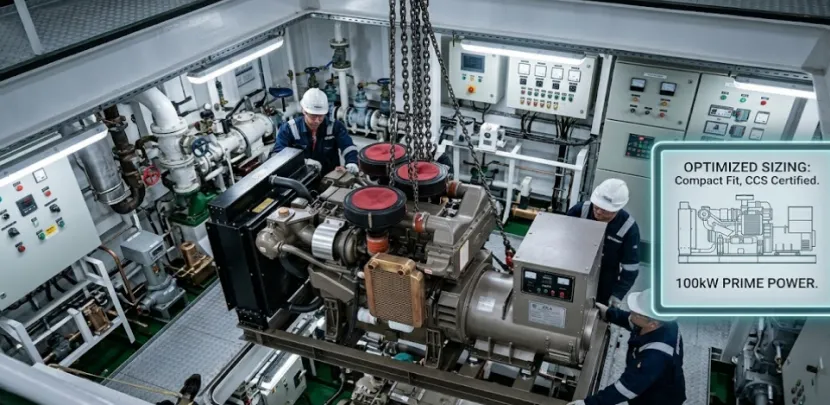
    Lifting 100kW UleenGen marine generator into ship engine room hatch.

    Which Product Details Should You Check?

    After the load estimate, the next step is matching it to a real machine, not a vague category.

    Frequency, Certification, and Layout

    On its marine product page, UleenGen’s marine generator line states that 50/60 Hz is available, the generator sets can serve as main power or backup power, and they carry CCS certification. The page also lists use cases such as fishing boats, ferries, yachts, tugboats, fire boats, and crew boats. Those details matter because a correct size still has to fit the vessel’s electrical standard, class needs, and physical layout.

    Fuel Use and Physical Size

    Catalog data helps you avoid abstract decisions. On the published 50 Hz specification table, the listed marine models run from 20 kW to 800 kW, with rated fuel consumption figures shown from 210 down to 190 g/kW·h depending on model. The same table also gives overall dimensions and gross weight. That is useful because some buyers focus on power and then remember too late that space in the engine room is not infinite.

    How Should You Make the Final Choice?

    Start with your real running load. Add motor starting demand. Leave a reasonable margin. Then compare that number with published genset ratings, dimensions, fuel figures, and class-related details.

    If you want a shortlist instead of a rough guess, the best move is to review vessel type, onboard equipment, operating hours, and frequency requirements together with a supplier. UleenGen’s contact and service pages can be a practical next stop if you need model matching based on your load list rather than a broad catalog search.

    常见问题解答

    Q1: What size marine generator do I need?
    A: Start with the loads that run at the same time, then add motor starting demand and a modest reserve. The right answer depends on your vessel type and duty cycle.

    Q2: Is a bigger genset always safer?
    A: No. An oversized generator can run too lightly for long periods, which raises fuel cost and can create low-load engine issues.

    Q3: Why is motor starting load important?
    A: Pumps, compressors, and fans may need much more power at startup than during normal running. Ignoring that is a common sizing mistake.

    Q4: Can one diesel generator work as main power and backup power?
    A: Some marine generator sets are offered for either role. UleenGen’s marine product page states that its generators can be used as main power or backup power.

    Q5: Which catalog details matter besides kW?
    A: Check frequency, certification, dimensions, weight, and fuel consumption. Those details affect installation, class compliance, and daily running cost.