



اتصل بنا
-
3-2-1003 حديقة البرمجيات ، منطقة ويفانغ للتكنولوجيا العالية ، شاندونغ ، الصين
- +8615095247272
- sales@uleengen.com
-


Marine and Port Applications: What to Ask Diesel Generator Manufacturers


Marine and port projects need a diesel generator specification that reflects the actual berth, terminal, yard, or shore-power duty. A harbor application label gives you a starting point. It does not define the rating, enclosure, electrical interface, environmental treatment, documents, or service scope for your installation.
Before you compare quotations, ask manufacturers for written answers about five areas: load and duty, site environment, electrical integration, equipment scope, and evidence for commissioning and lifecycle support. This question-led approach helps you compare equivalent configurations and identify items that remain to be confirmed for the destination.
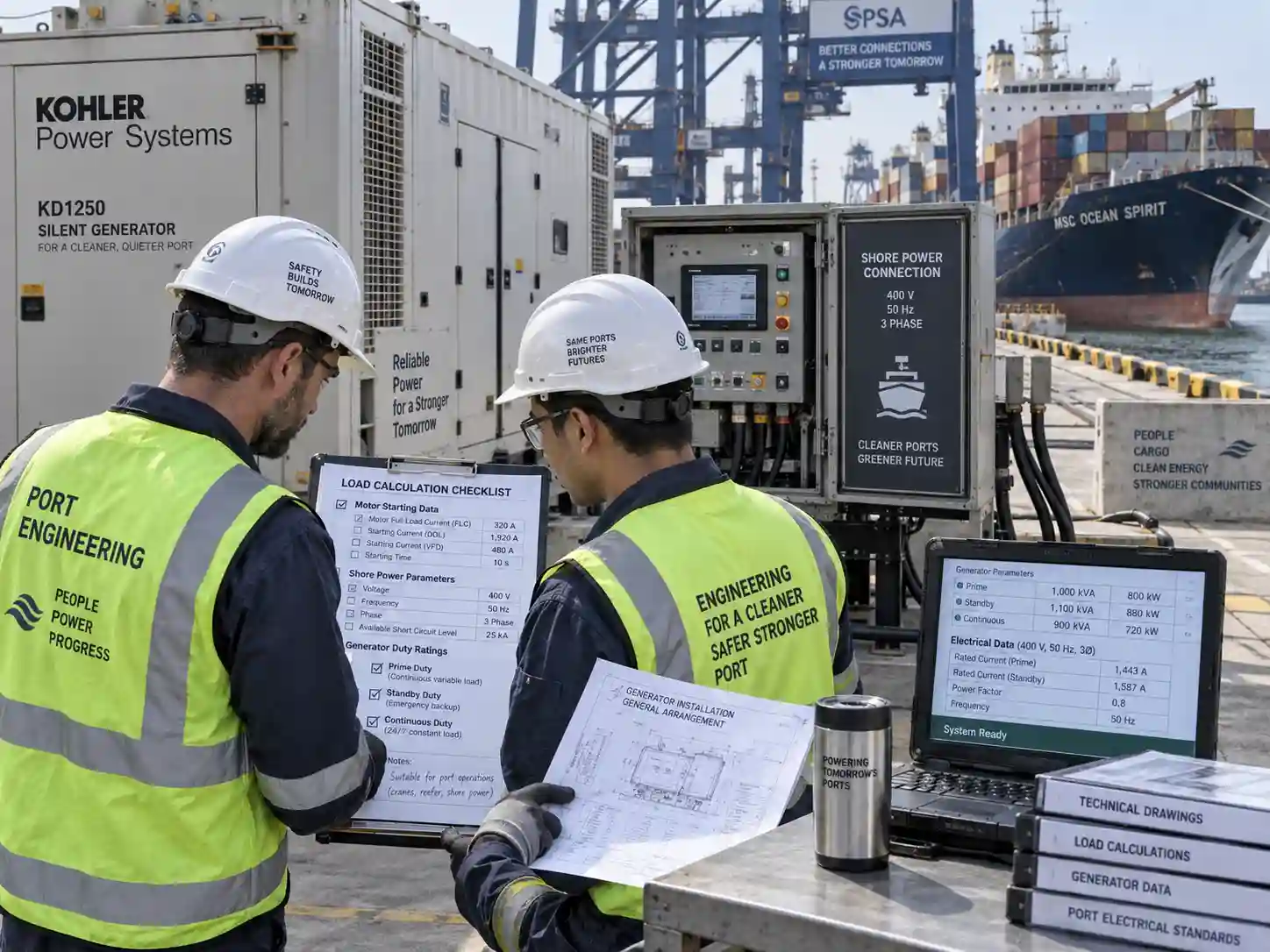
What Should You Ask a Diesel Generator Manufacturer Before a Marine or Port Purchase?
A useful enquiry includes the equipment list, running and starting data, operating hours, voltage, frequency, phase, site conditions, enclosure needs, transfer arrangement, and required documents. State whether the set will support shore power, cargo-handling equipment, a shipyard, construction work, emergency loads, or a rental fleet. The manufacturer can then connect the request to a model, rating basis, and component schedule.
Define the Port or Marine Load
Identify Shore, Vessel-Support, and Emergency Duties
1. Can the Diesel Generator Match the Marine or Port Load?
Ask the manufacturer to review every connected load. List cranes, pumps, compressors, welders, lighting, HVAC, workshops, navigation or communications equipment, battery chargers, and control systems with their running kW or kVA. Add motor size, starting method, starting sequence, and the loads that must remain energized during a utility interruption.
The quote should state whether the set uses a prime, standby, or continuous rating. Prime power follows a defined variable-load operating schedule. Standby power supports emergency operation during a utility outage. Continuous-duty work requires a rating and maintenance plan that match extended operation. Request the power factor, frequency, ambient reference, and load-step assumptions used for selection.
| Question for the manufacturer | Evidence to request |
|---|---|
| What output covers the running and starting load? | Model data sheet with kW/kVA, power factor, and load-step basis |
| Which duty rating applies? | Prime, standby, or continuous definition on the quotation |
| Can the alternator handle the starting sequence? | Voltage and frequency response information for the proposed configuration |
| Which loads start first or shed? | Written load sequence and control assumptions |
For family-level screening, you can review diesel generator sets by power range. Treat catalog ranges as a route to candidate families. Ask for the exact model rating before approval.
2. How Will the Generator Handle the Site Environment?
Send the manufacturer the port location, altitude, design ambient temperature, exposure to salt air, rain, dust, wash-down water, and prevailing ventilation conditions. Ask how these conditions affect cooling, filtration, enclosure materials, fasteners, cable entries, and service access. Request any model-specific derating in writing.
Discuss radiator airflow, exhaust routing, back pressure, foundation loading, lifting points, transport route, and clearances around service doors. A quay, yard, or temporary berth may need a trailer, silent canopy, open set inside a plant room, or containerized structure. Fuel tank position, refueling access, spill controls, and cable distance to the distribution board also belong in the site brief.
Marine classification approval, corrosion-protection systems, ingress protection, shock or vibration ratings, noise limits, and port-authority requirements depend on the project and destination. Ask the manufacturer to identify the available evidence, test method, and responsibility for each requirement. A catalog application reference does not establish those approvals.
3. Which Electrical and Control Interfaces Are Included?
Confirm the destination voltage, frequency, phase, neutral arrangement, grounding method, fault level, breaker frame, power factor, and cable termination. A 50 Hz system and a 60 Hz system require different alternator and engine settings. Shore connection, vessel-support loads, and port distribution boards may also use different switching and protection arrangements.
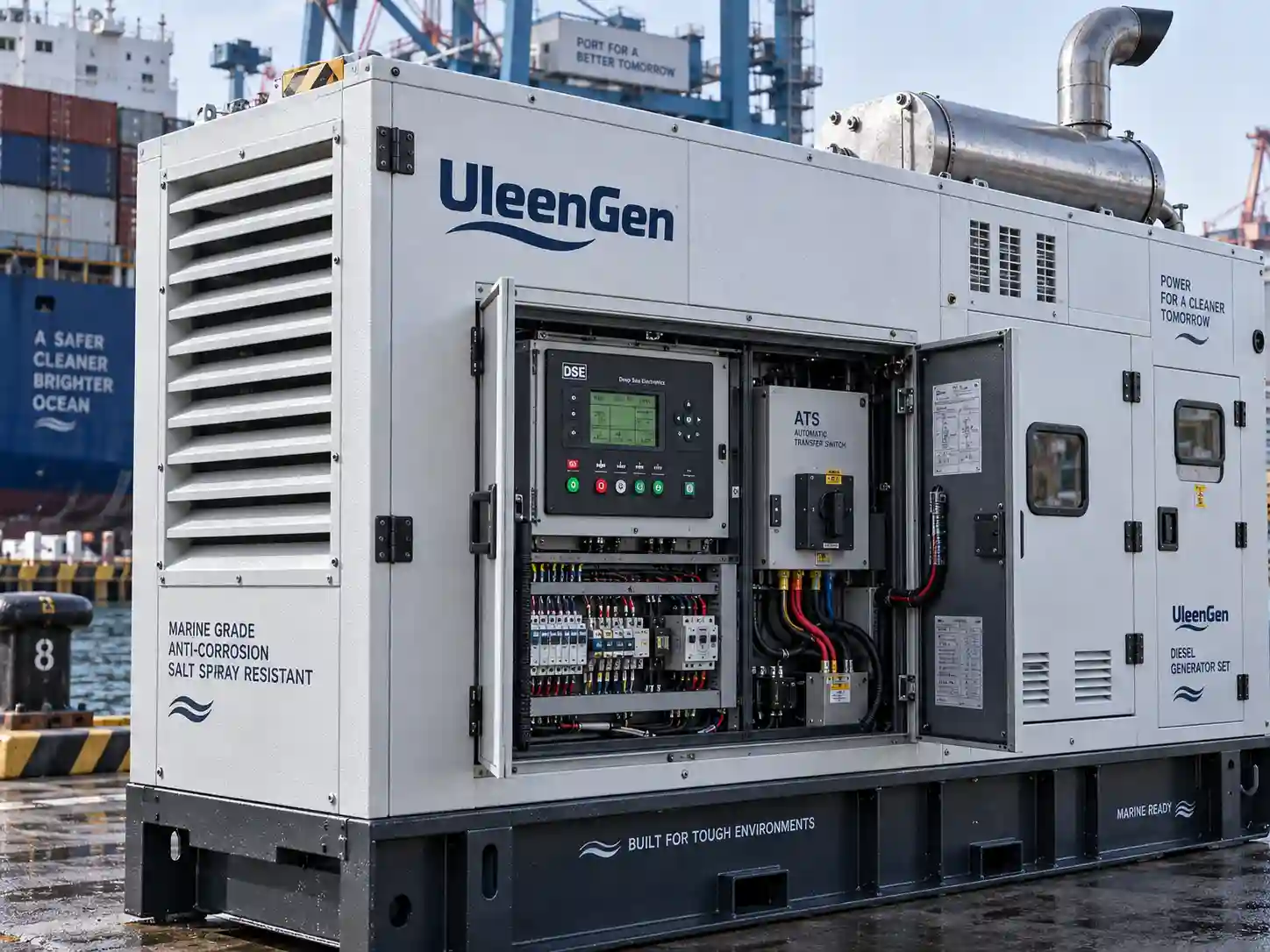
Ask whether the quotation includes an automatic transfer switch (ATS), synchronizing or paralleling controls, shore-power interlocking, remote monitoring, heaters, sensors, or a permanent and temporary connection panel. An ATS transfers selected loads between utility and generator sources. Synchronization controls coordinate multiple sets or a utility source under a defined scheme. The proposal should identify the controller, communication interface, alarm list, protection functions, and grounding connections.
UleenGen materials list controller options such as HGM6120, AMF25, DSE6120, DSE7320, HGM410, MRS16, DKG309, and DSE6020. Alternator options include Stamford, Leroy Somer, Mecc Alte, Marathon, EvoTec, and Wattek. These options require model-level confirmation. You can review generator sets by engine and structure after the electrical brief is prepared.
4. What Equipment and Enclosure Does the Quote Cover?
Ask for a complete component schedule. It should identify the engine model, alternator model, controller, breaker, cooling system, batteries, charger, base frame, fuel tank, silencer, exhaust parts, emergency stop, heaters, sensors, ATS, synchronization equipment, and monitoring hardware. Request the rated and standby output separately, with frequency, voltage, phase, power factor, and ambient reference.
UleenGen catalog materials list open, silent, trailer, and containerized structures. The selected structure affects transport, ventilation, access, cable routing, and installation work. Ask about canopy construction, doors, lifting points, tank integration, weather protection, corrosion treatment, and the boundary between factory supply and site work. A marine or port project should record every exclusion before comparing prices.
5. Which Documents, Tests, and Service Commitments Will You Receive?
Request the documents that allow electrical, civil, safety, and operations teams to approve the design:
-
rated and short-circuit data;
-
dimensional, foundation, lifting, and cable-entry drawings;
-
wiring diagrams and ATS or synchronization logic;
-
operation, installation, and maintenance manuals;
-
factory test records with stated load and conditions;
-
packing list, exclusions, delivery point, and warranty responsibilities;
-
spare-parts list, maintenance schedule, and commissioning responsibilities.
Ask who supplies operator training, troubleshooting, replacement parts, inspection support, and service records. UleenGen installation material covers ventilation, exhaust, foundation, clearances, grounding, utility and ATS connections, batteries, fuel, lifting, storage, and pre-start inspection. Use these topics to build the commissioning checklist, then request instructions for the exact model and site.
Projects with salt air, outdoor exposure, temporary deployment, or vessel-support duty should also ask for the inspection evidence relevant to the destination. The manufacturer should state which documents exist, which tests were performed, and which approvals remain the buyer’s responsibility. Review generator installation and service support when defining that work package.
Select a Diesel Generator Supplier with Written Marine and Port Answers
Your supplier comparison is ready when every offer describes the same load, duty, environment, electrical interface, components, documents, and responsibility boundaries. Send the manufacturer the project location, destination voltage and frequency, phase, operating hours, starting data, altitude, ambient temperature, salt-air exposure, enclosure type, ATS or synchronization plan, inspection requirements, and required drawings.
Shandong Uleen Generator Co., Ltd. lists harbor applications alongside construction, factories, mining, oil fields, data centers, telecommunications, highways, hospitals, and supermarkets. Its materials cover Cummins, Perkins, Yuchai, Weichai, Doosan, Deutz, Isuzu, and Ricardo engine families, plus open, silent, trailer, and containerized structures. Ask UleenGen for an itemized industrial diesel generator quotation that names the exact model, rating basis, component scope, test records, manuals, and site assumptions.
أسئلة متكررة
Q1: What should a port operator ask a diesel generator manufacturer first?
A: Start with the load and duty. Provide running kW or kVA, motor-starting data, load sequence, operating hours, voltage, frequency, phase, and the loads that must remain energized. Then ask the manufacturer to state the exact model and prime, standby, or continuous rating.
Q2: Does a harbor application listing prove marine suitability?
A: No. An application listing identifies a use category. Marine suitability may require destination-specific evidence for corrosion protection, ingress protection, vibration, noise, emissions, classification, or port approval. Ask the manufacturer to identify the applicable test records and approval responsibilities.
Q3: Which environmental details affect a port generator quotation?
A: Provide altitude, ambient temperature, salt-air exposure, rain, dust, wash-down, ventilation, exhaust routing, foundation, lifting, access, cable distance, fuel arrangements, and enclosure location. These details affect derating, cooling, filtration, structure, and installation scope.
Q4: What electrical information should be sent with a marine generator enquiry?
A: Send voltage, frequency, phase, neutral and grounding arrangement, fault level, breaker and protection requirements, power factor, cable termination, ATS or synchronization plan, shore connection details, and monitoring requirements. The quotation should connect each item to the proposed alternator and controller.
Q5: Which documents should a diesel generator manufacturer provide?
A: Request the exact data sheet, dimensional and foundation drawings, lifting and cable-entry details, wiring diagrams, ATS or synchronization logic, operation and maintenance manuals, factory test records, packing list, exclusions, warranty responsibilities, spare-parts list, and commissioning scope.


